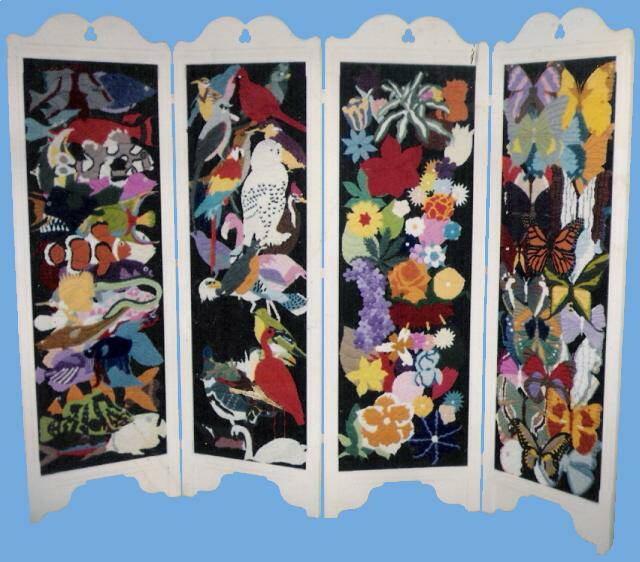
What Is Needlepoint?
By: Carolyn McNeil
1/1/2008
One of the most confusing aspects of needlepoint is defining the different terms used in needlework. The term "needlework" is the broadest term used to describe any form of creative endeavor that is worked using a needle. Among the many varieties of needlework exists the term "needlepoint", but we will get to that in a moment… Embroidery, quilting, rug making, knitting and crocheting are also covered under the
Stitch-opedia
An Encyclopedia of Stitches...
Welcome to Stitchopedia
Stitchopedia is an informational site,
dedicated to the art of needlepoint.
Our goal is to teach everyone - from
the beginner to the old pro. Here, you will find diagrams and directions for any stitch you can think of (and some you've probably never heard of). If you know of any stitches that I have missed (yes, there are probably quite a few), drop me an email and I will add it to the site. Just use the navigation above and click on the type of stitch you are interested in learning about - or - select a specific stitch from the navigation on the right and left sides of the page. Note: You will not see any "flash" on this site. Although that may sound a little boring, I am determined to keep this as simple a website as possible. Basically, you will see easy navigation (with a google search box for your added convenience), easy-to-follow diagrams and instructions, plus suggested needlepoint kits and tools that I recommend.
Page Set-up:
On the left side of each page you will see
our basic navigation followed by an
alphabetical list of stitches that are
demonstrated in this website. This list of stitches continues on the right side of each page. Click on a specific stitch and you will be directed to the page demonstrating that stitch. You may also use the google search box to search for a specific stitch. Simply type in the stitch you are looking for, check the www.stitchopedia.com box ( if this box is not checked the search will be web-wide) and click on search. At this time, you will be directed to a list of search results.
Included on each page are advertisements. We have selected ads that compliment this site. For example, each stitch page will showcase a few needlepoint kits that may be of interest. We have also included ads for sewing machines, craft projects and other related items. If you scroll down further
you will see advertisements for
Amazon.com, Ebay, Blockbuster and
anything we feel would be of interest
(basically, that means anything that I
find interesting...) Why include
advertisements? The advertising is where we make $$$ to pay for this website...
Our promise to you: We will never use ads that direct you to offensive sites, gambling sites or sites that could potentially harm your computer.
At the top and bottom of each page you will see navigation that is divided into the five basic needlepoint stitch types plus the basics. If you choose to use this navigation each button will take you to a page with a list of stitches in that particular stitch group. For example, Crossed Stitches will list all stitches in the cross stitch group - this is any stitch that crosses itself at some point.
Each page contains a series of diagrams - illustrating the stitch - plus step-by-step instructions for working the stitch. Underneath each diagram and instructional text you will find this:
By clicking on this icon, you will open a new window with a "printable version" of the stitch. Simply print this page and refer to it when necessary. This is for those of us who do not work our needlepoint projects while sitting at the computer....
Some pages may load slower than others due to the size of the diagrams. Be patient. It will be worth the wait...
HAPPY STITCHIN'...
Alex-Paras NeedleArts offers needlepoint supplies, patterns and information to the needlework community
NEEDLEPOINT THREADS
KREINIK METALLIC THREADS
BLANK NEEDLEPOINT CANVAS
HAND-PAINTED NEEDLEPOINT CANVAS
***Stitch Index*** (Alphabetical)
A - I
Support This Site! Make a donation thru Paypal...
***Stitch Index*** (Alphabetical)
I - Z

Plus more
DESIGNS BY CAROLYN
coming soon!
Support This Site! Make a donation thru Paypal...
Copyright 2006...Stitchopedia...All Rights Reserved
enormous umbrella of the term "needlework" In this article; we will be discussing needlepoint, embroidery, and tapestry.
First of all, let us get tapestry out of the way. The term "tapestry" is often misused in connection with needlepoint and embroidery. This is not a form of needlework. It is, however, a form of "textile art". Tapestry is a woven fabric, created by hand or
machine. The design is created through an intricate weaving process. Needlepoint and embroidery works are often confused with tapestry work because the finished products closely resemble each other. In the simplest terms, needlepoint and embroidery are worked ON the canvas or fabric, whereas tapestry IS the fabric.
Now let us move on to embroidery. Embroidery is the art of embellishing or
19th century embroidery was referred to as "canvas work". During the 16th, 17th and 18th centuries the term "petit point" was commonly used to describe embroidery. Today, petit point refers to needlepoint that is worked on canvas that is 16-mesh or smaller. There are two different methods of classifying embroidery. The first method divides embroidery into two groups: surface embroidery and, as previously
mentioned, canvas work. Surface embroidery encompasses any design that is worked on top of the fabric. Canvas work consists of any design that is stitched into the canvas. These two terms are very broad and not very enlightening. I prefer the second method of classifying embroidery. The second method divides embroidery into two groups that are easier to understand: counted thread embroidery and free embroidery. Counted thread embroidery consists of any piece that is worked using a pre-determined pattern. The pattern may be printed on the fabric or
Finally, we come to needlepoint. What is needlepoint? Needlepoint, as I stated earlier is a form of embroidery. Remember, embroidery was commonly referred to as "canvas work" before the 19th century. Today, canvas work is called needlepoint. While embroidery is worked on either cloth or canvas, needlepoint is worked primarily on canvas.
not. Counted cross stitch and are the two stitches that have pre-determined counted patterns. There are literally hundreds of needlepoint stitches. Many of these stitches started out as embroidery stitches. Yes, I said needlepoint is a form of embroidery. I will get to that in a moment… Free embroidery is a form of embroidery that does not worry about the foundation fabric. A free embroidery piece is worked without counting or design. Each stitch is placed independently, hence the name. Crewel work is an excellent example of free embroidery.
Woolen yarns are used for stitching needlepoint projects. Needlepoint stitches are "patterned" stitches. That is to say, stitches that have pre-determined counted patterns.There are literally hundreds of needlepoint stitches. Many of these stitches started out as embroidery stitches and have been adjusted for needlepoint canvas. Some of the more common needlepoint stitches are: , bargello, gobelin stitch, basketweave, tent stitch, continental stitch, back stitch, chain stitch, and diagonal stitch. These are just a few of the many needlepoint stitches available today.
These are the definitions of tapestry, embroidery and needlepoint in the most simple of terms. Basically, tapestry is the art of weaving the design into a fabric, thus becoming the fabric itself. Embroidery is the art of embellishing and decorating an existing fabric. Needlepoint is the art of working the design into canvas. Whichever type of needlework you choose to engage in, all have the capacity to give many hours of creative pleasure to you.

decorating textile fabric. Almost any fabric may be embroidered. The two most common materials for embroidery are cotton or linen. Throughout the centuries, clothing, furniture and a large assortment of other day to day items have been embroidered. Almost any type of thread may used for embroidery, floss being the most common. Believe it or not – in the past human hair was used to embroider. Personally, I prefer to keep my hair attached to my head and use floss for my embroidery projects. Often, objects may be embroidered into a piece. Decorative stones, beads or shells can be worked into a fabric using embroidery. Until the
Advertisements...
Craft supplies and other products of interest...