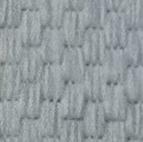
creates an interesting pattern, suitable for backgrounds. This stitch should always be worked using straight stitches that are four canvas threads in length. Two diagrams have been used to demonstrate this stitch. Clicking on the PRINTABLE VERSION icon, located at the end of the series of diagrams, will direct you to the page to print these instructions.
All You've Ever Wanted To Know About Embroidery
By: Samantha Brown
What is Embroidery?
Embroidery is decorative needlework used on clothing and other textiles. The word embroidery may come from two different places, one a Frankish word meaning braid, the other a Germanic word meaning border or edge. There are many different kinds of embroidery in the world and there is no clear concept of who may have done the first embroidery in the world. An art form with a long history in almost every culture the many styles and variations that have been created throughout the years are not surprising. However, most kinds of embroidery fall into one of two main categories.
Two Main Categories of Embroidery
There are two main categories of embroidery. The first, known as counted-thread embroidery includes styles like cross-stitch and needlepoint. All counted-thread embroidery is made by counting the individual threads of the canvas being embroidered when placing a stitch. Even textured fabrics like cotton or linen are usually used along with cotton embroidery floss to reproduce grid like patterns and pictures.
The second kind is known as free embroidery. Unlike counted-thread embroidery, free embroidery does not pay attention to the individual threads of the canvas. Instead it is able to spray freely across fabric, allowing for more realistic and less constrained designs. Chinese embroidery is an example of free embroidery.
Embroidery Embellishments
There are many different kinds of decorative stitches. Some of the most commonly used stitches are the straight stitch, the cross stitch and the knot stitch.
A straight stitch goes up and down through fabric and will tend to move in a single direction. Cross stitching is usually done by creating a series of diagonal lines going one way and then going back along the line to create turn each angled stitch into an individual x. Knot stitches are made by wrapping thread around a needle while it moves through the fabric. The result is a tiny nub on the upper side of the fabric. It is used frequently as the center point of a flower.
Intricate embroidery has long been a sign of wealth. The number of jewels and decorations on individual's apparel is a time-honored sign of power and respectability. Embroidery can be done with a wide range of textiles and can be embellished with almost any material. Beads, charms and other ornaments made of glass, metal, plastic and wooden can all be incorporated into embroidery. There are practically an unlimited number of ways to create embroidery and just as many accent pieces can be used for additional embellishments.
Art or Craft
Creating beautiful embroidery is both a handcraft and an art. Many kinds of embroidery can be done well after only a little practice. Many areas in the world use embroidery styles that are distinct to their locale. A study of the many kinds of embroidery shows how time and fashion has created new styles of embroidery to take advantage of modern innovations. While there are some people who use complex embroidery machines to speed up the process of embroidery, the age-old hobby will always be of interest and the finest results of the art will always be in demand. Supplies for most kinds of embroidery are easy to find at both craft supplies and fabric stores.
About The Author:
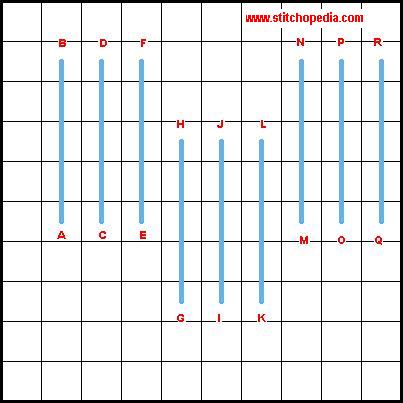
Algerian Filling Stitch
(Diagram 1):
Bring the needle up at A, move up over four canvas threads, bring the needle down at B. Bring the needle up at C, move up over four canvas threads, bring the needle down at D. Bring the needle up at E, move up over four canvas threads, bring the needle down at F. Bring the needle up at G, move up over four canvas threads, bring the needle down at H. Bring the needle up at I, move up over four canvas threads, bring the needle down at J. Bring the needle up at K, move up over four canvas threads, bring the needle down at L. Bring the needle up at M, move up over four canvas threads, bring the needle down at N. Bring the needle up at O, move up over four canvas threads, bring the needle down at P. Bring the needle up at Q, move up over four canvas threads, bring the needle down at R. This completes the first row of algerian filling stitches. Now, continue on to Diagram 2...
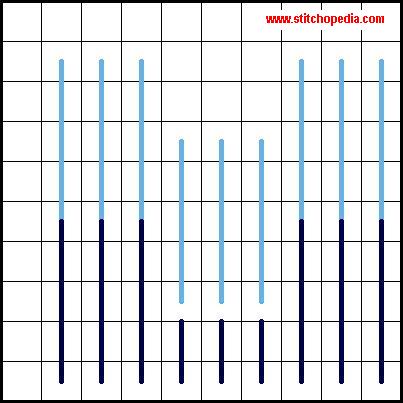
Algerian Filling Stitch (Diagram 2):
The second row is worked in exactly the same manner as the first row. The second row has been illustrated in Dark Blue above. As you can see from the diagram, shorter stitches should be worked when larger stitches will not fit - specifically, when you reach the end of the canvas or area that you are working on. Reminder: The basics algerian filling stitches should be four canvas threads long.