Different Embroidery Frames
By: Robbie Darmona

There are different types of embroidery frames. Sometimes, the mere choosing of the most proper embroidery frame for your canvas can be as exasperating as the stitching itself. That is why you should be presented with the various opportunities that different embroidery frames offer.

The first opportunity is not to pick up any embroidery frame. In some cases frames are not necessary, as in canvas work, like painted canvas kits, tassels and Hapsberg lace samples.

Another thing to have in mind is that embroidery frames differ in their price. The inexpensive frames are suitable in some cases, but can be inappropriate in more sophisticated embroidery projects. The inexpensive frames are Ring frames, Q-snaps and Stretcher bar frames.

1)Ring frames are best when the frame is 1 inch deep. If the slot is narrower, the fabric can easily slip. The frames can be wooden or plastic, wooden are the better. The fabric must be kept tight in the frame, but with ring frames several difficulties occur. With smaller fabrics, narrower frames are sufficient to keep the cloth taut. But when the fabric is bigger and the embroidery work more complicated, ring frames are easy to let the canvas slip, they cannot hold it tight enough. Plastic frames are easier to let go of the fabric than wooden ones.

2)Q-snaps are another inexpensive type of embroidery frames. Plastic bars are slotted together and the fabric is clipped on a plastic frame. Another piece of plastic is also slotted over the fabric. But the cloth is not taut enough and can easily slip, compared to the scroll bars, stretcher bars and slate frames used in stitching.

3) Stretcher bars are fairly inexpensive and can be the best possible solution for any kind of embroidery. The stretcher bar frames are wooden and the fabric is kept perfectly taut. The bars are sold in pairs, and every bar has dog teeth that keep the tightness of the fabric. Pairs of stretcher bars can be combined together for bigger fabrics. You can form a rectangular shape for the frames by using two pairs. This type of embroidery frames is perfect for Goldwork kits, Shadow embroidery, Whitework kits, Needle painting kits and modern Jacobean kits.

Then come the more expensive types of embroidery frames used on special projects. They are the following:
1) Scroll frames. They have two pairs of bars screwed to one another so that a rectangular shape is acquired. The only drawback is that sometimes the screws get loose and the fabric is not kept tight. But if this is neglected, scroll bars are perfect, as they can be left on a floor or a table, on virtually any kind of surface, and leave your hands free: you don’t need to hold the frames all the time. The side bars that fit into holes with the main top and bottom bars can sometimes be too short for your fabric, so you must be careful when choosing the size of the frame. Being too short, the side bars can influence the smoothness of the fabric and can leave creases.

2) The second embroidery frame is slate frames. The main bars have tape staples onto which you fit the fabric. Slate frames also have trestles, with which they stand on stable surface. They are extremely comfortable. The side arms are slightly longer than the scroll frames, so that the fabric is protected from creasing.

3) Lacing. It is an improved version of the scroll frames. Scroll frames use only the main bars for tension over the fabric. With lacing, the fabric is sewn on the four sides, on the side bars as well, to ensure better tension so that the canvas is better stretched. If the fabric is soft and tears easily, sew a tape of curtain cloth on the edges and then attach them to the bars.

About the Author:
Article by Robbie Darmona www.robbiedarmona.com - an article writer who writes on a wide variety of subjects. For more information click Embroidery Frames www.theneedlework.com
Article Source: http://www.hobbyarticledirectory.com
Back Stitch with Curves (Diagram 3):
Bring the needle up at A, move to the right over two canvas threads, bring the needle down at B. Bring the needle up at C, move to the right over two canvas threads, bring the needle down at A. Bring the needle up at D, move to the right over two canvas threads, bring the needle down at C. Bring the needle up at E, move down and to the right  over one canvas intersection, bring the needle down at D. Bring the needle up at F, move down and to the left  over one canvas intersection, bring the needle down at E. Bring the needle up at G, move to the left over two canvas threads, bring the needle down at F. Bring the needle up at H, move to the left over two canvas threads, bring the needle down at G. Bring the needle up at I, move to the left over two canvas threads, bring the needle down at H. Continue working the back stitch in this manner until the S-R stitch is complete. Note: Diagram 3 is only one example of the back stitch worked with curves. This stitch may be used to outline or create other types of curved lines.
Print Me
BACK STITCH
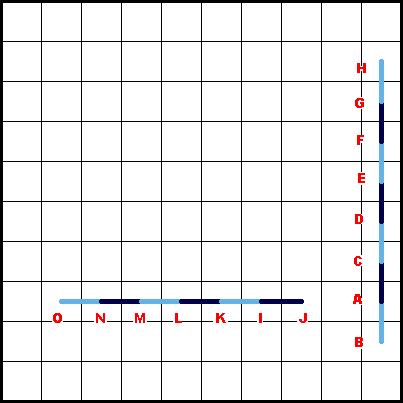
Back Stitch Diagram - Vertical and Horizontal Method
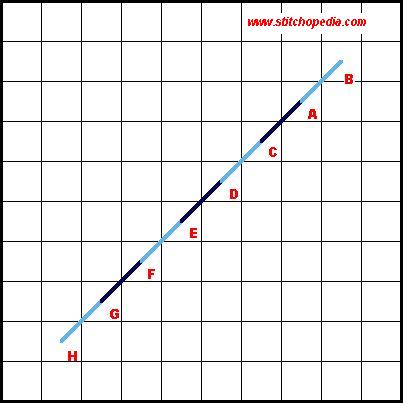
Back Stitch Diagram - Diagonal Methond
The Back Stitch is used to outline areas of needlepoint work. This stitch should not be used to cover vast areas of canvas or background work. This stitch is also
Back Stitch (Vertical Method):
From bottom to top - Bring the needle up at A, go down over 1 thread and bring the needle down at B. Go up over 2 threads, bring the needle up at C. Go down over 1 thread and bring the needle down at A. Go up 2 threads, bring the needle up at D. Go down 1 thread and bring the needle down at C. Continue in this manner until the end of the row.
From top to bottom - Bring the needle up at G, go up 1 thread and bring the needle down at H. Go down 2 threads, bring the needle up at F. Go up 1 thread and bring the needle down at G. Go down 2 threads and bring the needle up at E. Go up 1 thread and bring the needle down at F. Continue in this manner until the end of the row.

Back Stitch (Diagonal Method):
From top to bottom - Bring the needle up at A, move up and to the right over 1 canvas interlock and bring the needle down at B. Move down and to the left over 2 canvas interlocks and bring the needle up at C. Move up and to the right over 1 canvas interlock and bring the needle down at A. Move down and to the left over 2 canvas interlocks and bring the needle up at D. Move up and to the right over 1 canvas interlock and bring the needle down at C. Continue in this manner until the end of the row.
Print Me
 
convenient for covering exposed areas of other stitches. The Back Stitch may be worked vertically, horizontally or diagonally. Whichever method you choose, you may work in any direction. You may also use this stitch to create curved lines, as demonstrated in Diagram 3. Three diagrams have been used to demonstrate this stitch, one for each method. Clicking on the PRINTABLE VERSION icon, located at the end of the series of diagrams, will direct you to the page to print these instructions.
Back Stitch (Horizontal Method):
From right to left - Bring the needle up at I, move over 1 thread and bring the needle down at J. Moving left, move over 2 threads and bring the needle up at K. Move over 1 thread (to the right) and bring the needle down at I. Move left over 2 threads and bring the needle up at L. Move to the right over 1 thread and bring the needle down at K. Continue in this manner until the end of the row.
From left to right - Bring the needle up at N, move to the left over 1 thread and bring the needle down at O. Move to the right over 2 threads and bring the needle up at M. Move to the left over 1 thread and bring the needle down at N. Move to the right over 2 threads and bring the needle up at L. Move to the left over 1 thread and bring the needle down at M. Continue in this manner until the end of the row.

From bottom to top - Bring the needle up at G, move down and to the left over 1 canvas interlock and bring the needle down at H. Move up and to the right over 2 canvas interlocks and bring the needle up at F. Move down and to the left over 1 canvas interlock and bring the needle down at G. Move up and to the right over 2 canvas interlocks and bring the needle up at E. Move down and to the left over 1 canvas interlock and bring the needle down at F. Continue in this manner until the end of the row.
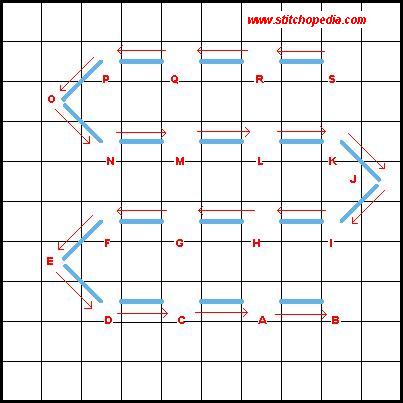
Back Stitch with curves - Diagram 3
Print Me
Do you have a sample of this stitch that you would like to share? If so, click here...

HOME

ABOUT US

CONTACT US!

SITE MAP

LINKS


***Stitch Index*** (Alphabetical)
A - I

2,4,6,8 & Tie Stitch

Algerian Eye Stitch

Algerian Eye Daisy
Stitch

Algerian Filling Stitch

Algerian Plait Stitch

Alternating Cross
Stitch

Astrakhan Stitch

Aubusson Stitch

Back Stitch

Bargello Stitch

Basketweave Stitch

Bazaar Stitch

Binding Stitch

Bokhara Couching Stitch

Bokhara Couching Stitch (Diagonal)

Bokhara Couching Stitch (Staggered)

Brazilian Stitch

Brick Stitch

Brighton Stitch

Bullion Knot

Buttonhole Stitch

Buttonhole Stitch (Detached)

Buttonhole Stitch (Double)

Buttonhole Stitch (Tailored)

Buttonhole Stitch (Whipped)

Buttonhole Wheel
Stitch

Byzantine Stitch

Cable Stitch

Cashmere Stitch

Chain Stitch

Chain Stitch
(Braided Variation)

Chain Stitch
(Heavy Variation)

Chain Stitch
(Interlaced Variation)

Chain Stitch (Lazy
Daisy Variation)

Chain Stitch
(Raised Variation)

Checker Stitch

Continental Stitch

Coral Knot Stitch

Couching Stitch

Couching Stitch (Buttonhole Variation)

Couching Stitch (Herringbone Variation)

Couching Stitch
(Open Chain  Variation)

Cretan Stitch

Cretan Stitch
(Diagonal Variation)

Cross Stitch

Cross Stitch (Bound)

Cross Stitch (Diagonal)

Cross Stitch (Heavy)

Cross Stitch (Houndstooth)

Cross Stitch (Reinforced)

Cross Stitch
(Reversed Double)

Cross Stitch
(Staggered)

Cross Stitch (St.Andrew)

Cross Stitch
(St.George)

Cross Stitch (Trame)

Cross Stitch (Triple)

Cross Stitch
(Two-Sided)

Cross Stitch
(Woven)

Cushion Stitch

Czar Stitch

Diagonal Stitch

Darning Stitch

Diagonal Buttonhole Stitch

Diagonal Interlaced Stitch

Diagonal Leaf Stitch

Diamond Stitch

Diamond Eyelet Stitch

Diaper Pattern Stitch

Double Cross Stitch

Double Knot Stitch

Double Star Stitch

Double Stitch

Double Straight
Cross Stitch

Droit Stitch

Eastern Stitch

Economic Stitch

Egyptian Stitch

Encroaching Slanted Gobelin Stitch

Eye Stitch

Eye Stitch with Backstitch

Fan Stitch

Fancy Stitch

Feather Stitch

Fern Stitch

Fishbone Stitch

Fishbone Stitch (Diagonal)

Flame Stitch

Flat Stitch

Flat Stitch (Crossed)

Florentine Stitch

Florentine Stitch (Split)

Fly Stitch (Closed)

French Knot

French Stitch

Ghiordes Knot

Gobelin Stitch

Gobelin Droit Stitch

Gobelin Filling Stitch

Gobelin Stitch
(Trammed Upright)

Greek Stitch

Half Cross Stitch

Herringbone Stitch

Herringbone Stitch (Double)

Herringbone Gone Wrong Stitch

Herringbone Stitch
(Six Step)

Hobnail Stitch

Hungarian Stitch

Hungarian Diamond Stitch

Hungarian Ground
Stitch

Hungarian Ground
Stitch (Diagonal)

Hungarian Point Stitch

Interlocking Gobelin Stitch


***Stitch Index*** (Alphabetical)
I - Z

Irish Stitch

Jacquard Stitch

Kalem Stitch

Kelim Stitch

Kilim Stitch

Knitting Stitch

Knitting Stitch (Diagonal)

Knitting Stitch
(Reverse Tvistom)

Knotted Stitch

Knotted Stitch (Single)

Ladder Stitch

Leaf Stitch

Leaf Stitch (Diagonal)

Leaf Stitch with Backstitch

Leviathan Stitch

Leviathan Stitch (Double)

Leviathan Stitch
(Triple)

Long Armed Cross Stitch

Long Stitch

Long and Short Stitch

Loop Stitch

Mexican Cross Stitch

Milanese Stitch

Montenegrin Stitch

Moorish Stitch

Mosaic Stitch

Mosaic Stitch (Crossed)

Mound Stitch

Nobuko Stitch

Oblique Stitch

Oblique Stitch (Diagonal)

Oblique Stitch (Reverse)

Oblique Slav Stitch

Oblong Cross Stitch

Oblong Cross Stitch with Backstitch

Oriental Stitch

Outline Stitch

Palestrina Stitch

Palace Pattern Stitch

Paris Stitch

Parisian Stitch

Pavillion Stitch

Perspective Stitch

Plait Stitch

Plait Stitch (Crossed)

Plait Stitch (Square)

Plaited Edge Stitch

Plaited Gobelin Stitch

Plaited Interlaced Stitch

Portuguese Cross Stitch

Portuguese Stem Stitch

Princess Pattern Stitch

Pyramid Stitch

Quick Point

Raised Stitch

Raised Cross Stitch

Ray Stitch

Ray Stitch (Expanded)

Renaissance Stitch

Rep Stitch

Reverse Bargello

Reversed Basketweave Stitch

Reversed Cross Stitch

Rhodes Stitch

Ribbed Wheels Stitch

Rice Stitch

Rice Stitch (Padded)

Rococco Stitch

Roman Stitch

Rope Stitch

Roumanian Stitch

Rug Binding Stitch

Rya Stitch

Satin Stitch

Satin Stitch
(Alternating)

Satin Stitch
(Padded)

Scotch Stitch

Scotch Stitch (Alternating)

Scotch Stitch (Condensed)

Scotch Stitch (Crossed)

Scotch Stitch (Woven)

Scottish Stitch

Sheaf Stitch

Shell Stitch

Single Knotted Stitch

Slanted Gobelin Stitch

Smyrna Cross Stitch

Sorbello Stitch

Soumak Stitch

Spanish Stitch

Spider Web Stitch

Split Stitch

Sprats Head Stitch

Square Plait Stitch

Star Stitch

Star Stitch (Large)

Stem Stitch

Stem Stitch
(Diagonal)

Stepped Sheaf Stitch

Surrey Stitch

Sutherland Pattern Stitch

Tapestry Stitch

Tent Stitch

Tent Stitch (Alternating)

Tent Stitch
(Diagonal Mosaic)

Tie Stitch

Trame

Trammed Tent Stitch

Triangle Stitch

Tufting Stitch

Turkey Stitch

Tvistom Stitch

Two Sided Italian
Cross Stitch

Upright Cross Stitch

Van Dyke Stitch

Velvet Stitch

Waffle Stitch

Wave Stitch (Closed)

Wave Stitch (Open)

Weaving Stitch

Web Stitch

Wheat Sheaf Stitch

Woven Band Stitch

Woven Pattern Stitch

BACK TO TOP

The Basics     Composite Stitches     Crossed Stitches    Diagonal Stitches     Looped Stitches     Straight Stitches
Home     About Us     Contact Us      Site Map     Article Archive     Links

Copyright 2006...Stitchopedia...All Rights Reserved
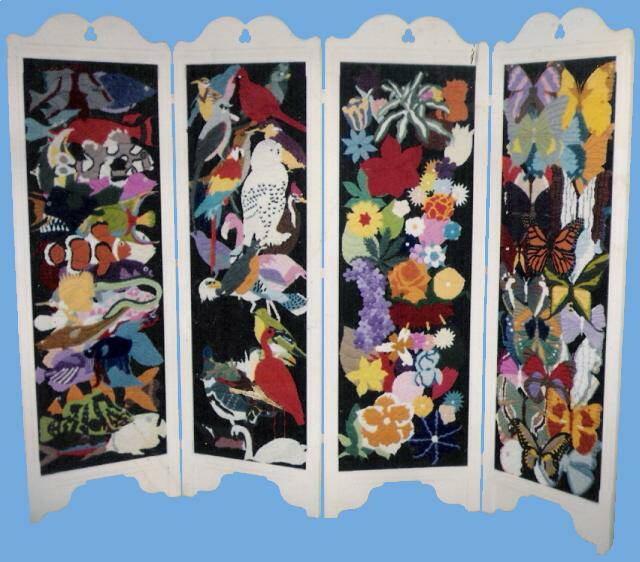
The Four F's (Fish, Fowl, Flowers, Flutterbys)The Four F's (Fish, Fowl, Flowers, Flutterbys)
The Four F's (Fish, Fowl, Flowers, Flutterbys)The Four F's (Fish, Fowl, Flowers, Flutterbys)The Four F's (Fish, Fowl, Flowers, Flutterbys)
The Four F's (Fish, Fowl, Flowers, Flutterbys)The Four F's (Fish, Fowl, Flowers, Flutterbys)The Four F's (Fish, Fowl, Flowers, Flutterbys)The Four F's (Fish, Fowl, Flowers, Flutterbys)
The Four F's (Fish, Fowl, Flowers, Flutterbys)The Four F's (Fish, Fowl, Flowers, Flutterbys)The Four F's (Fish, Fowl, Flowers, Flutterbys)
The Four F's (Fish, Fowl, Flowers, Flutterbys)The Four F's (Fish, Fowl, Flowers, Flutterbys)
The Four F's (Fish, Fowl, Flowers, Flutterbys)
The Four F's (Fish, Fowl, Flowers, Flutterbys)The Four F's (Fish, Fowl, Flowers, Flutterbys)
The Four F's (Fish, Fowl, Flowers, Flutterbys)The Four F's (Fish, Fowl, Flowers, Flutterbys)The Four F's (Fish, Fowl, Flowers, Flutterbys)
The Four F's (Fish, Fowl, Flowers, Flutterbys)The Four F's (Fish, Fowl, Flowers, Flutterbys)The Four F's (Fish, Fowl, Flowers, Flutterbys)The Four F's (Fish, Fowl, Flowers, Flutterbys)
The Four F's (Fish, Fowl, Flowers, Flutterbys)The Four F's (Fish, Fowl, Flowers, Flutterbys)The Four F's (Fish, Fowl, Flowers, Flutterbys)
The Four F's (Fish, Fowl, Flowers, Flutterbys)The Four F's (Fish, Fowl, Flowers, Flutterbys)
The Four F's (Fish, Fowl, Flowers, Flutterbys)
The Four F's (Fish, Fowl, Flowers, Flutterbys)The Four F's (Fish, Fowl, Flowers, Flutterbys)
Stitch-opedia

An encyclopedia of needlepoint Stitches...

Bookmark and Share