
BAZAAR STITCH
The Bazaar Stitch is a member of the herringbone stitch family. It is also known as the Six Step Herringbone Stitch. It is an
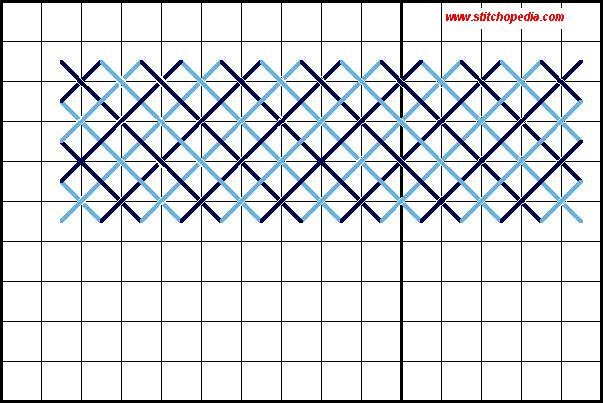
excellent choice for working borders. This stitch covers well, creating a thick, weaved, padded look. Four diagrams have been used to demonstrate this stitch.
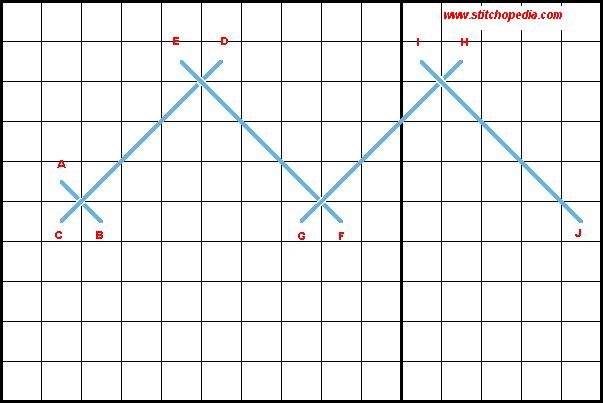
Bazaar Stitch (Diagram 1):
Bring the needle up at A, move down and to the right over one canvas intersection, bring the needle down at B. Bring the needle up at C, move up and to the right over four canvas intersections, bring the needle down at D. Bring the needle up at E, move down and to the right over four canvas intersections, bring the needle down at F. Bring the needle up at G, move up and to the right over four canvas intersections, bring the needle down at H. Bring the needle up at I, move down and to the right over four canvas intersections, bring the needle down at J. Now, continue on to Diagram 2...
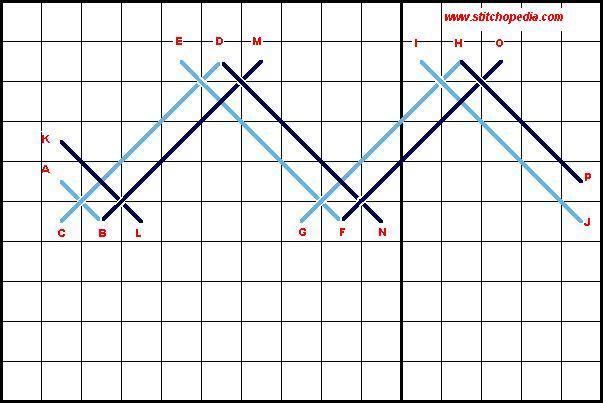
Bazaar Stitch (Diagram 2):
This row is illustrated in dark blue. We begin this row where we began the last row, working left to right. Bring the needle up at K, move down and to the right over two canvas intersections, bring the needle down at L. Bring the needle up at B, move up and to the right over four canvas intersections, bring the needle down at M. Bring the needle up at D, move down and to the right over four canvas intersections, bring the needle down at N. Bring the needle up at F, move up and to the right over four canvas intersections, bring the needle down at O. Bring the needle up at H, move down and to the right over three canvas intersections, bring the needle down at P. Now, continue on to Diagram 3...
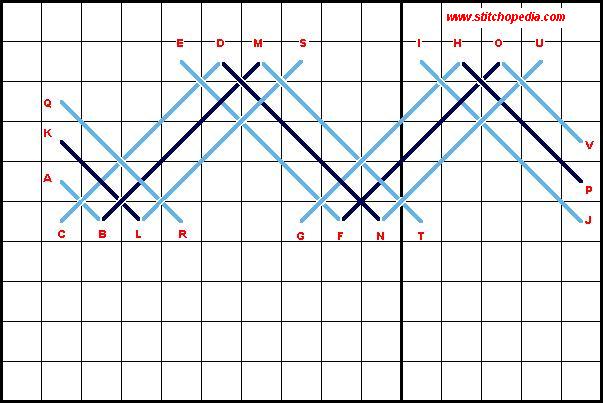
Bazaar Stitch (Diagram 3):
This row is illustrated in light blue. Agan, we begin this row where we began the last row, working left to right. Bring the needle up at Q, move down and to the right over three canvas intersections, bring the needle down at R. Bring the needle up at L, move up and to the right over four canvas intersections, bring the needle down at S. Bring the needle up at M, move down and to the right over four canvas intersections, bring the needle down at T. Bring the needle up at N, move up and to the right over four canvas intersections, bring the needle down at U. Bring the needle up at O, move down and to the right over two canvas intersections, bring the needle down at V. Now, continue on to Diagram 4...
Bazaar Stitch (Diagram 4):
This diagram illustrates how the bazaar stitch should look when complete. (Well, sort of....the actual weaved effect is more apparent in a real project...)
 | ||||||
Stitch-opedia
An encyclopedia of needlepoint Stitches...

Copyright 2006...Stitchopedia...All Rights Reserved
*Stitch Index*
Select the first letter of the stitch you are looking for...
*Stitch Index*
Select the first letter of the stitch you are looking for...
| ||||||
