
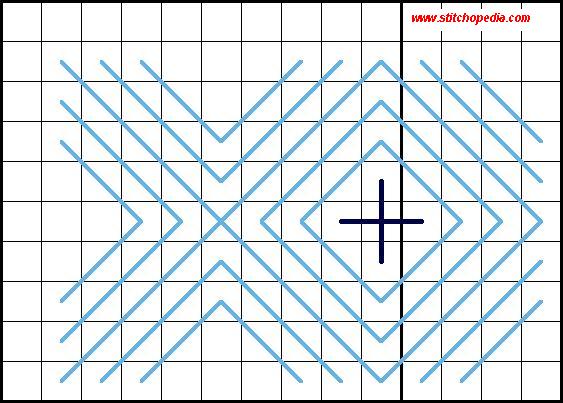
image". At the center of each block of diagonal stitches, an upright cross stitch is added. You may choose to use a different color yarn for the upright cross stitch. This will create an interesting effect. Three diagrams have been used to demonstrate this stitch.
BRIGHTON
STITCH
The Brighton Stitch consists of blocks of diagonal stitches. The blocks alternate to create a "mirror-
A
B
C
D
E
F
G
J
H
I
K
L
M
N
P
Q
O
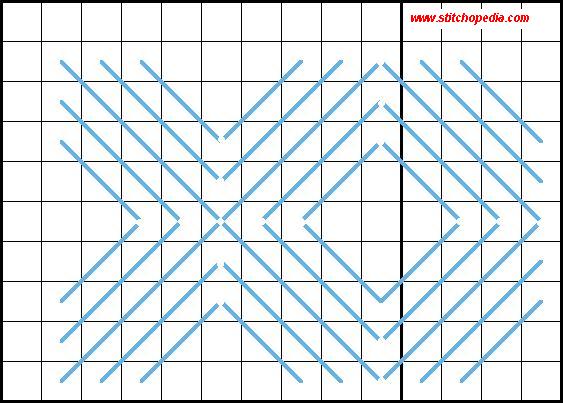
Brighton Stitch (Diagram 2):
This diagram illustrates how the second row should be worked into the first row. When the second row is complete, continue on to Diagram 3...
Brighton Stitch (Diagram 3):
Once you have completed the diagonal stitches, it is time to add the upright cross stitch. The upright cross stitch should be added to the middle of each block.
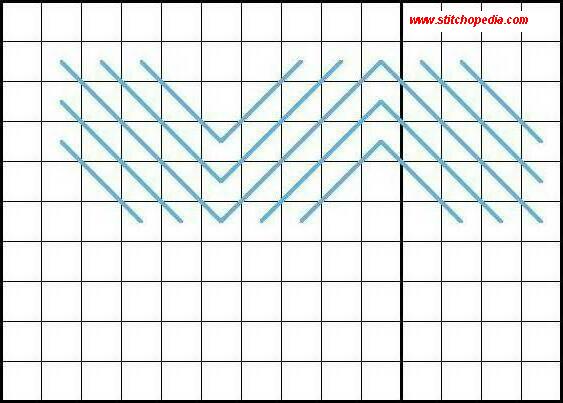
Brighton Stitch (Diagram 1):
Bring the needle up at A, move up and the the right over two canvas intersections, bring the needle down at B. Bring the needle up at C, move up and to the right over three canvas intersections, bring the needle down at D. Bring the needle up at E, move up and to the right over four canvas intersections, bring the needle down at F. Bring the needle up at G, move up and to the right over three canvas intersections, bring the needle down at H. Bring the needle up at I, move up and to the right over two canvas intersections, bring the needle down at J. Bring the needle up at K, move up and to the left over two canvas intersections, bring the needle down at J. Bring the needle up at L, move up and to the left over three canvas intersections, bring the needle down at H. Bring the needle up at M, move up and to the left over four canvas intersections, bring the needle down at F. Bring the needle up at N, move up and to the left over three canvas intersections, bring the needle down at O. Bring the needle up at P, move up and to the left over two canvas intersections, bring the needle down at Q. Now, continue on to Diagram 2...
 | ||||||
Stitch-opedia
An encyclopedia of needlepoint Stitches...

Copyright 2006...Stitchopedia...All Rights Reserved
*Stitch Index*
Select the first letter of the stitch you are looking for...
*Stitch Index*
Select the first letter of the stitch you are looking for...
| ||||||
