
CHAIN STITCH (INTERLACED)
Although the Interlaced Chain Stitch is considered an embroidery stitch, it works
extremely well when used on canvas. This is a decorative stitch that consists of regular chain stitches, interlaced with small looped stitches (hence the name, interlaced chain stitch). The interlacing stitches should be worked in a color that constrasts with the chain stitch color. It is recommended that a thin yarn, like metallic thread, be used for the interlacing. A yarn that is too thick will cover the original chain stitch and the true effect of this stitch will be lost. The interlaced chain stitch is not appropriate for any piece that will have heavy wear. Three diagrams have been used to demonstrate this stitch. Clicking on the PRINTABLE VERSION icon, located at the end of the series of diagrams, will direct you to the page to print these instructions.
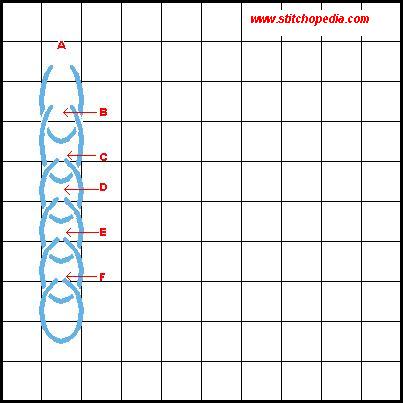
Interlaced Chain Stitch (Diagram 1):
Bring the needle up at A, move down over two canvas threads and form a loop. Holding the loop in place with your thumb, bring the needle down at A. Bring the needle up at B, move OVER the first chain stitch (chain stitch A), form a loop and bring the needle down at B. This second chain stitch will hold the first chain stitch in place. Bring the needle up at C, move OVER chain stitch B, form a loop and bring the needle down at C. Again, this chain stitch will hold the previous chain stitch in place. Bring the needle up at D, move OVER chain stitch C, form a loop and bring the needle down at D. Bring the needle up at E, move OVER chain stitch D, form a loop and bring the needle down at E. Bring the
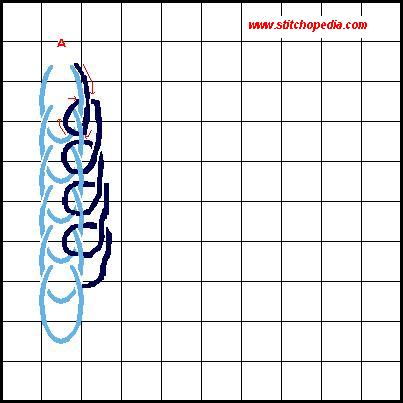
Interlaced Chain Stitch (Diagram 2):
This is where we add the interlacing. The interlacing is illustrated in dark blue. Bring the needle up at A, follow the red arrows around the first chain stitch, under the second chain stitch, around to the first chain stitch, then under the first chain stitch and continue down to the next chain stitch. Although it sounds a little complicated, if you simply follow the arrows in the above diagram, the pattern will turn out to be very easy. Continue working the
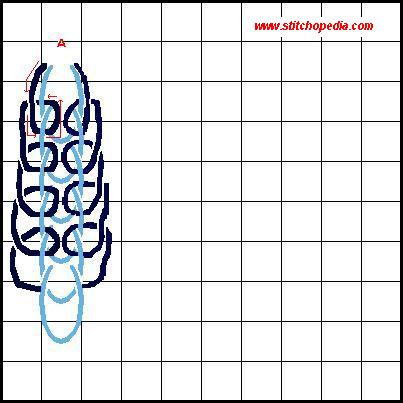
Interlaced Chain Stitch (Diagram 3):
This is where we add the interlacing to the other side of the chain.. Again, the interlacing is illustrated in dark blue. Bring the needle up at A, follow the red arrows around the first chain stitch, under the second chain stitch, around to the first chain stitch, then under the first chain stitch and continue down to the next chain stitch. This side is worked exactly
needle up at F, move OVER chain stitch E, form a loop and bring the needle down at F. At the end of each row, you will need to add a small anchor stitch in order to hold the last chain stitch in place. Now, continue on to Diagram 2...
interlacing in this manner until you reach the end of the row. At the end of the row, tie off the interlacing. Then, continue on to Diagram 3...
the same as the previous side. Continue working the interlacing in this manner until you reach the end of the row. Be sure to tie off the interlacing when you reach the end of the row.
Do you have a sample of this stitch that you would like to share? If so, click here...
towns, and each ceased to think of himself as a bit of a class in a nation. They knew that each one was creating the neighborhood, the town, the colony.
To women who knew this, every precious scrap of cloth had a new meaning; they thought of what the small pieces, together, could make. And they began to make a pattern of them.
From this simple beginning, in the crazy quilt and the Log Cabin pattern. American women developed the whole vast treasure of American patchwork, pieced
and appliqued, that we are still developing.
From scraps and bits they made the English Rose, the French Lily, the Dutch Tulip, the Irish Chain, the Indian Tree of Life, and with patches they recorded American history, all of it, from Bear's Paw and Tomahawk to California Poppy and Hawaiian Pineapple.
They quilted - and quilt - their patchwork in webs of tiny stitches; they added touches of embroidery and bits of lace. In originality, in beauty and meaning, nothing
else in the whole world's needlework compares with American patchwork.
Yet for more than a hundred years American students of folk arts did not notice it; they were admiring the Old World's peasant crafts. Only recently have curators of American museums seen American needlework.
Yet in 1776 its spirit of freedom was nearly two centuries old.
For more than a year British ships had blockaded Boston and British troops had occupied the hungry city. Americans had
fought and died at Lexington, at Concord, on Breed's Hill and at Charleston. The Green Mountain men had taken Ticonderoga. British armies were coming down the Hudson and a British war fleet with troopships was nearing New York harbor when at last, losing all hope of freedom with peace, the gentlemen of the Continental Congress soberly risked their lives, dipping a quill pen in an inkhorn and signing their Declaration.
"We hold these truths to be self-evident, that all men are created equal, that they are endowed by their Creator with certain un-alienable Rights, that among these are Life, Liberty and the pursuit of Happiness... We, therefore, the Representatives of the United States of America ... appealing to the Supreme Judge of the world for the rectitude of our intentions, do, in the Name, and by Authority of the good People of these Colonies, solemnly publish and declare, That these United Colonies are, and of Right ought to be Free and Independent States.".
American History Through The Eye Of A Needle - Part 4
By: John Wigham
Only one form of American needlework is wholly American, without root or kin in the Old World; that is our pieced patchwork. Oh, patches are nothing new.
Ancient Egyptians sewed fabric to fabric, and in medieval Europe women applied cloth to cloth. Patches are as old as poverty. In rags and patches the first workers came to America. Patches belonged to workers, to the poor, low-class subjects of
the ruling classes. Patchwork was always a task, not an art.
Poverty came across the ocean with the immigrants. Here on the farthest rim of the known world, it became direst need. The smallest scrap of cloth was precious to a woman who could have no more cloth until the trees were cut and burned, the land spaded and sown to flax or to grass for sheep, then next year the wool sheared, washed, combed, carded and
spun, or the flax pulled and carefully rippled, retted, dried, beetled, scutched, heckled, spun, and at last the loom made, the warp threaded, the shuttles wound and the cloth woven.
In a wilderness thousands of miles from home, depending only upon themselves for their very lives, these poor immigrants learned the inescapable fact that a person is the only source of the only energy that preserves human life on this planet. With their minds and hands they made houses, they produced food, they wove cloth and built
About The Author: John Wigham has been a professional
author and editor for 20 years and is a co-founder of Patterns Patch an online cross stitch club dedicated to counted cross stitch. The website has a small team of writers who are devoted to our cross stitch club and enjoy writing about their hobby.
***Stitch Index*** (Alphabetical)
A - I
***Stitch Index*** (Alphabetical)
I - Z
Copyright 2006...Stitchopedia...All Rights Reserved
An encyclopedia of needlepoint Stitches...