
American History Through The Eye Of A Needle - Part I
By: John Wigham
More than 100 years ago at the dawn of the 20th century one of America's most distinguished authors, Rose Wilder Lane, was asked to write a report on the history
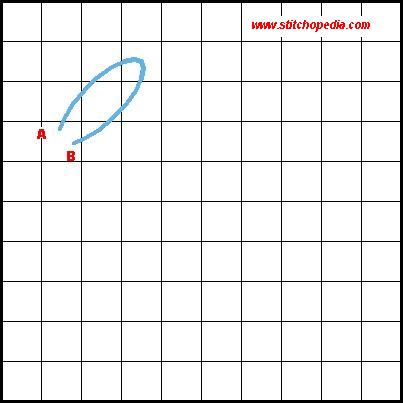
Lazy Daisy Chain Stitch (Diagram 1):
This type of chain stitch is similar to the Lazy Daisy Stitch. The Daisy-like appearance looks good when worked over a filling background stitch. Bring the needle up at A. Holding your thumb over enough yarn to cover 1 canvas space (as shown), bring the needle down at B (the original canvas space where we started). Now, move on to Diagram 5....
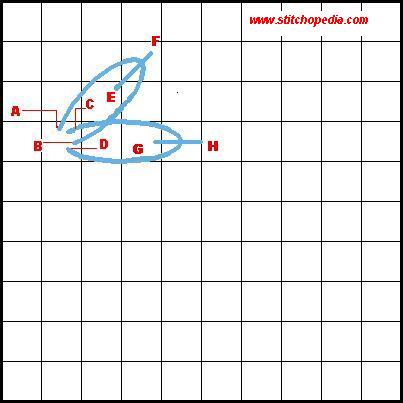
Lazy Daisy Chain Stitch (Diagram 2):
Continue holding your thumb over the loop you have created with your first stitch. Starting where we left off at B, go up 1 canvas thread and move to the right over 1 canvas thread, bring the needle up at E. Move to the right, diagonally, cross over 1 canvas intersection and bring the needle down at F. This stitch should go OVER the chain stitch to anchor it in place. Moving on to the next chain stitch, we start where we left off at F.Go down 2 canvas threads and move to the left over 2 canvas threads, bring the needle up at C (the canvas space we started with). Holding your thumb over enough yarn to cover 2 canvas spaces (as shown), bring the needle down at D (the space we started from). Move to the right over 2 canvas threads and bring the needle up at G. Move to the right over 1
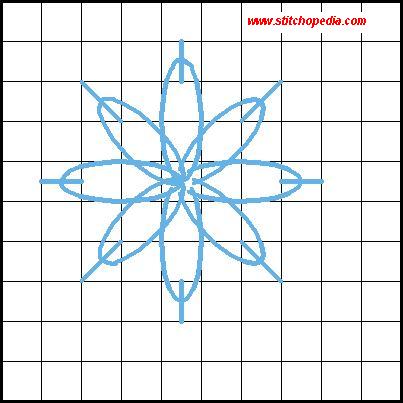
Lazy Daisy Chain Stitch (Diagram 3):
This diagram illustrates how the lazy daisy chain stitch should look when complete.
The Lazy Daisy Chain Stitch forms a daisy when complete. Basically, this is a series of
chain stitches forming a circle and anchored with tent stitches. The lazy daisy chain stitch is a decorative stitch that is simple to work. Three diagrams have been used to demonstrate this stitch. Clicking on the PRINTABLE VERSION icon, located at the end of the series of diagrams, will direct you to the page to print these instructions.
canvas thread and bring the needle down at H. Again, this stitch should go OVER the chain stitch to anchor it in place. Continue in this manner, following Sample 1, below....
Do you have a sample of this stitch that you would like to share? If so, click here...
and homes and everlasting satisfaction to themselves and their families.
Mrs Lane's original report has been split up into this five-part series of articles and is virtually unchanged from her original script.
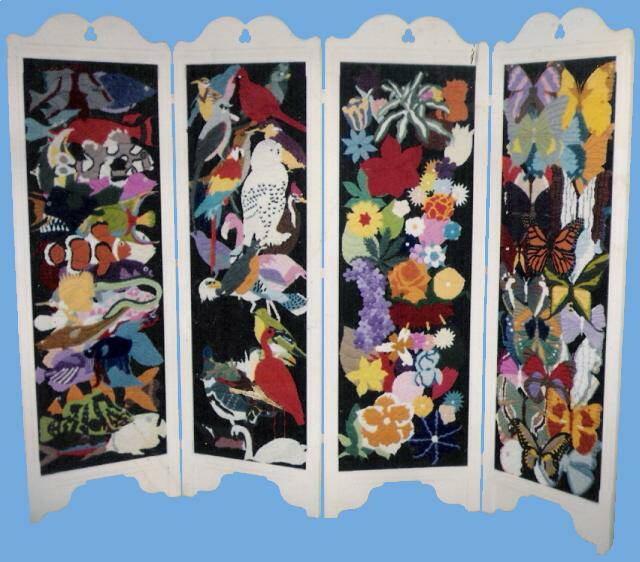
Needlework is the art that tells the truth about the real life of people in their time and place. The great arts, music, sculpture, painting, literature, are the work of a few unique persons whom lesser men emulate, often for generations. Needlework is anonymous; the people create it. Each piece is the work of a woman who is thinking only of making for her child, her friend, her home or herself a bit of beauty that pleases her.
So her needlework expresses what she is, more clearly than her handwriting does. It expresses everything that makes her an individual unlike any other person - her character, her mind and her spirit, her experience in living. It expresses, too, her country's history and culture, the traditions, the philosophy, the way of living that she takes for granted.
The first thing that American needlework tells you is that Americans live in the only classless society. This republic is the only country that has no peasant needlework. Everywhere else, peasant women work their crude, naive, gay patterns, suited to their humble class and frugal lives, while ladies work their rich and formal designs proper to higher birth and breeding.
American needlework is not peasant's work or aristocrats. It is not crude and it is not formal. It is needlework expressing a new and unique spirit, more American than American sculpture, painting, literature or classical music.
Three hundred years ago the colonies in America were European. Gentlemen and their ladies brought to North America the absolute monarchies of the Continent, the feudal system of England, and the arts and cultures of the Old World. They also brought the lower classes to do the hard work.
The workers who cleared the forests, planted the crops, hunted for the fur traders, and did the brewing, building, spinning and weaving were peasants hardly more free than serfs, bound
servants no more free than slaves, poor families imprisoned for poverty who were herded out of debtors' prisons and shipped to America, and poor girls who, having no dowries, were auctioned in American ports to woodsmen and freed servants who could afford to buy wives.
They came from the hungry classes in all the famine-plagued kingdoms of the Old World. They had nothing in common but their poverty, their humanity, and a wild hope. Long before British victory in European wars had seized for the British Empire
all the colonies in America except the Spanish Floridas and New France west of the Mississippi, the land that is now these States was the home of all mankind.
The Dutch built the town on Manhattan Island, and the patroons' large estates on Long Island and up the Hudson River valley. German peasants slowly defeated the Pennsylvania wilderness. Scotch-Irish struggled into the Carolina mountains. Swedes
settled Delaware. New France ran from Maine to Detroit to St. Louis and up the Mississippi from Mobile and New Orleans to Illinois, Missouri and the Dakota
headwaters of the Missouri River. New Spain stretched from Peru and Mexico to San Antonio, Los Angeles, San Francisco. The Russians came down from Alaska to Monterey.
Among all these pioneers, only a few at first, were Italians, Danes, Poles, Armenians, Assyrians, Czechs, Slovaks, Finns,
Greeks, Norwegians, Hungarians, Africans, Arabs, Egyptians, Levantines. Protestants ruled New England; Catholics governed Maryland; Jews were in all the colonies. All varieties of humankind were here, and all the languages, faiths, cultures.
By painful stages on wagon tracks through forests and by boats sailing along empty
coasts, the English, Irish, Scottish, Dutch, French and Spanish gentlemen were meeting on the neutral ground of their lofty social class. Beneath them the lower classes were mingling and intermarrying with each other and with the Indians - the farmers, the peddlars, the sailors, the little merchants, the wilderness
fighters; the first Americans.
About The Author: John Wigham has been a professional author and editor for 20 years and is a co-founder of Patterns Patch an online cross stitch club dedicated to counted cross stitch. The website has a small team of writers who are devoted to our cross stitch club and enjoy writing about their hobby.
and development of the needlework arts in America. Mrs Lane was the ideal writer for this worthy task being herself an expert needlewoman, historian, novelist, and essayist.
Her words gave radiance and meaning to the great needlework canvas and provided encouragement for the creative women of the time to carry on the great tradition of American needlework. This creativity brought beauty to their lives
***Stitch Index*** (Alphabetical)
A - I
***Stitch Index*** (Alphabetical)
I - Z
Copyright 2006...Stitchopedia...All Rights Reserved
An encyclopedia of needlepoint Stitches...