Poverty came across the ocean with the immigrants. Here on the farthest rim of the known world, it became direst need. The smallest scrap of cloth was precious to a woman who could have no more cloth until the trees were cut and burned, the land spaded and sown to flax or to grass for sheep, then next year the wool sheared, washed, combed, carded and spun, or the flax pulled and carefully rippled, retted, dried, beetled, scutched, heckled, spun, and at last the loom made, the warp threaded, the shuttles wound and the cloth woven. Only then could she hope for a few scraps to continue with her craft.
American History Through The Eye Of A Needle - Part 3
By: John Wigham
In typical Old World needlework, each detail is a particle of the whole; no part of the design can stand alone, whole and complete in itself. The background is solid, the pattern is formal, and a border encloses all.
American women smashed that rigid order to bits. They discarded backgrounds, they
The Raised Chain Stitch consists of regular chain stitches worked around a
series of laid straight stitches. This stitch creates a "raised" or textured appearance, which accounts for the name. The raised chain stitch is a decorative stitch and cannot endure heavy use. Four diagrams have been used to demonstrate this stitch. Clicking on the PRINTABLE VERSION icon, located at the end of the series of diagrams, will direct you to the page to print these instructions.
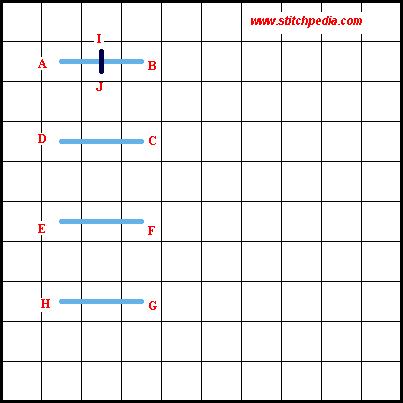


Raised Chain Stitch (Diagram 1):
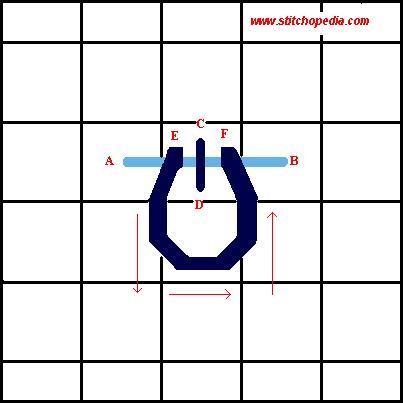
We begin this stitch by working a series of laid stitches. Bring the needle up at A, move to the right over two canvas threads, bring the needle down at B. Bring the needle up at C, move to the left over two canvas threads, bring the needle down at D. Bring the needle up at E, move to the right over two canvas threads, bring the needle down at F. Bring the needle up at G, move to the left over two canvas threads, bring the needle down at H. To begin the first chain stitch, bring the needle up at I, move over the A/B stitch and bring the needle down at J. The I/J stitch is illustrated in dark blue. Note: The I/J stitch and all of the chain stitches are worked around the laid (foundation) stitches
Raised Chain Stitch (Diagram 2):
This diagram is an enlarged version of the normal diagram. This will help to better illustrate the details of the chain stitches. Once the A/B laid stitch and the C/D filling stitch are complete, we will begin where we left off at D. Bring the needle up at E, follow the red arrows to create a small loop, hold the loop in place with your thumb and bring the needle down at F. Now, continue on to Diagram 3...
Raised Chain Stitch (Diagram 3):
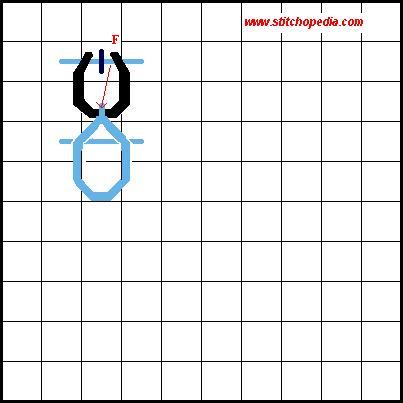
This diagram illustrates how the second chain stitch should be worked. While holding the previous loop in place with your thumb, bring the needle from F, move OVER the loop and bring the needle around to form the second chain (illustrated in light blue). Each new chain will hold the previous chain down. The last chain will need a tie
Raised Chain Stitch (Diagram 4):
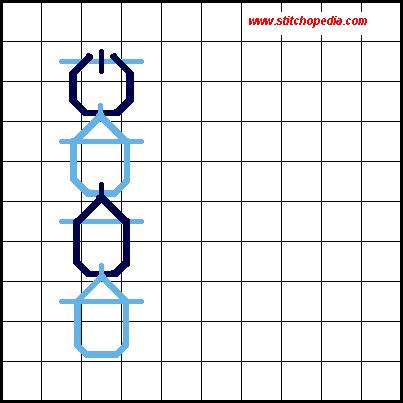
This diagram illustrates how a row of raised chain stitches should look when complete. Two colors have been used to better illustrate the stitch. Click on the Printable Version icon to print these diagrams and instructions.
NOT the canvas threads. Now, continue on to Diagram 2...
down stitch, as shown in the first chain. Now, continue on to Diagram 4...
Do you have a sample of this stitch that you would like to share? If so, click here...
American needlework an almost explosive energy.
No other needlework is so alive. There are no stiff forms to it, no monotonous repetitions. Leaves and flowers spring vigorously from living stems; buds burst open, squirrels frisk, deer leap, birds fly. Colors are clear and fresh and vibrant. No other needlework on earth is so strong, so free, so full of energy and movement.
Women in the European colonies began this revolution in needlework more than a
discarded borders and frames. They made the details create the whole, and they set each detail in boundless space, alone, independent, complete.
Just as individual freedom suddenly released the terrific human energy that swept the Old World's Great Powers from this hemisphere and wholly transformed North America in a third of the time that those Old World Powers had held it, so this reversal of meaning gives
hundred years before Americans broke clean away from the Old World and began to create a wholly new world.
English, French, and German women in the white towns and red farmhouses of New England and in the great houses of Maryland and Virginia took old patterns of Persia, India, Portugal, Holland and England and wrought them in crewel work transformed by the new American spirit.
They made the feather crest of the Prince of Wales into airy quilting patterns. French women changed the Lilies of France into living flowers. Dutch women on Long Island and German girls in Pennsylvania took the stiff tulip from their painted chests and worked it into their unique patterns of wholly American patchwork.
American women changed the English Rose into the Cherokee Rose, the Prairie Wild Rose, and the Texas Rose that vies with the Lone Star; different patterns all, and all charming.
Then from starving Ireland the Irish women brought the lace that America transformed into the wholly new crocheted lace that is the American "real" lace, the most varied, flexible, and free of the world's fine laces, the only lace that is made "in the air.".
The Italians and the Russians brought the cross-stitch; the Spanish brought outline; the Danes brought cutwork, the grandmother of all laces; Madeira sent drawnwork; Scots added the woven plaid, Scandinavians the hooked coverlet that American
Americans made Martha Washington's Flower Garden, the Oregon Trail, the Lone Star of Texas, the Atlantic Cable, so today American women are making patterns of the skyscraper sky lines, civic centers and parks, airplanes, Hawaii's Island Garden.
They are working into needlework murals our legends of Paul Bunyan and Johnny Appleseed and Daniel Boone.
Only one form of American needlework is wholly American, without root or kin in the Old World; that is our pieced patchwork. Oh, patches are nothing new. Ancient Egyptians sewed fabric to fabric, and in medieval Europe women applied cloth to cloth. Patches are as old as poverty. In rags and patches the first workers came to America. Patches belonged to workers, to the poor, low-class subjects of the ruling classes. Patchwork was always a task, not an art.
women transformed into our hooked rug; American Indians gave beadwork; Mexicans gave the Aztec patterns and the desert's blazing colors.
American women, children of all these lands, took all this and more and made it American in spirit. They changed it, combined its symbols, gave it space and freedom and energy; and they created a new folk art: American needlework.
We are still creating it. As colonial women made such designs as the Log Cabin, the Bear's Paw, the Tomahawk, the Pine Tree, the Wild Goose Flight; as nineteenth-century
About The Author: John Wigham has been a professional author and editor for 20 years and is a co-founder of Patterns Patch an online cross stitch club dedicated to counted cross stitch. The website has a small team of writers who are devoted to our cross stitch club and enjoy writing about their hobby.
***Stitch Index*** (Alphabetical)
A - I
***Stitch Index*** (Alphabetical)
I - Z
Copyright 2006...Stitchopedia...All Rights Reserved
An encyclopedia of needlepoint Stitches...