
art. Thus, the size and fashion of the tablecloth, its colour, and the pattern will depend on the size and shape, material and colour of the table it is made for. The tablecloth will become a part of interior, that is why it must be balance with the other things in the room.
You should be aware of some the main notions and means of composition in order to learn how to arrange a composition correctly. They are rhythm, rapport order, symmetry and others. All these notions in their turn are connected with the concept
The Composition In Folk Embroidery
By: Luda Sonkin
Today we shall talk about the composition in embroidery. You will get to know about ornaments and its use to decorate household stuff in times of old. Ornamental patterns decorate many things. If a thing is beautiful, it is pleasant to use it. You have many confections at home: fine china, in-wrought drapery, embroidered
The Coral Knot Stitch is actually an embroidery stitch. In recent years it has been adapted to work with canvas. This
stitch may be worked horizontally or vertically. Although the coral knot stitch is most commonly used as a filling stitch, it is also an excellent stitch for working outlines. As Each knot is tied, a 3-D effect is created. Experiment with this stitch - you may be surprised at the results... Two diagrams have been used to illustrate this stitch. Clicking on the PRINTABLE VERSION icon, located at the end of the series of diagrams, will direct you to the page to print these instructions.
Coral Knot Stitch (Diagram 1):
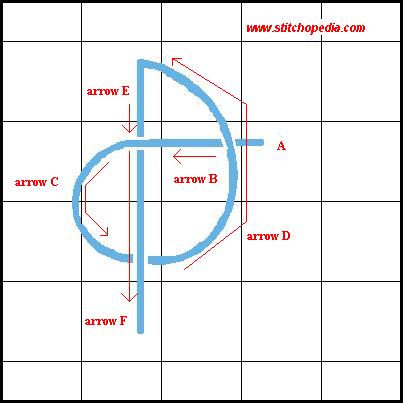
Bring the needle up at A, move to the left, following arrow B. Create a loop by moving down and following arrow C. Move to the right and up following arrow D. Now, move down and UNDER the A/B loop following arrow E. Continue moving down and OVER the C/D loop following arrow F. This completes the first coral knot. Yes, I realize knots are difficult to illustrate. However, if you follow the above diagram very carefully and practice a
Coral Knot Stitch (Diagram 2):
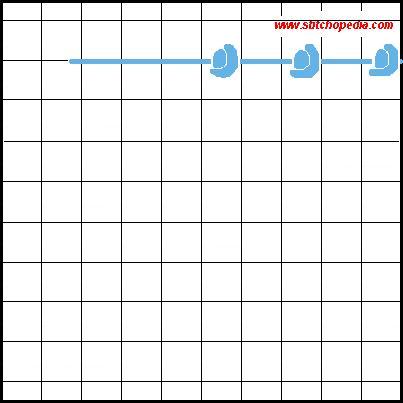
This diagram illustrates (sort of - it's the best I can do) how a row of three coral knot stitches should look when complete. As you can see, a knot is placed in every other canvas hole, with each knot being worked from the same length of yarn. Note: The coral knot stitch is worked on and around the canvas thread, per the illustration in Diagram 2.
few knots, it should come more easily. Remember, "practice make perfect..." Now, continue on to Diagram 2...
Do you have a sample of this stitch that you would like to share? If so, click here...
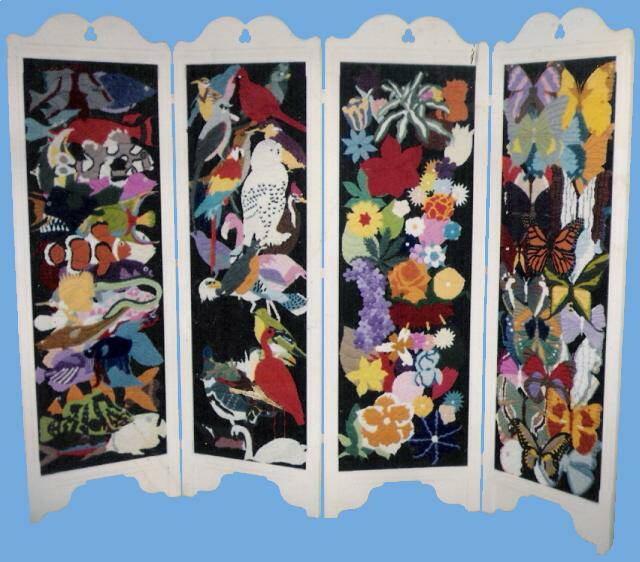
The works of the folk craftsman delight us in colour schemes, amazing pictures of plants, birds and animals. Patterns are wonderful: flowers, outlandish birds, and thin
cushions, ovenware… Try to decorate them yourself.
In former times only a few could buy fine things. In the villages away from big cities people made and decorated the things they needed themselves – wooden spoons, plates, water scoops and other. Some of them survived to our times. Many of such things are elaborately made. Now they are kept in museums. We do not know the names of those who made them, but their art is called folk art.
and neat branches of trees. And what colours!
How could the folk craftsman create such a gorgeous design?
Who could give him a cue?
It was the nature that directed him; he had seen it in the forest or in the garden. Look carefully at the plants, how their leaves grow, what their shape is, what the colours are.
Before making something, you should think the whole item over, decide upon the shape, arranging of the pattern, it character and colour. The artistic solution of the ornament is included into the general concept of composition.
The Latin word “composition” means arranging separate parts into a complete unit in a certain order. Together these parts are supposed to create a definite shape. In the properly designed composition all the elements are interconnected, it is impossible to remove anything without the loss of integrity of the picture and the harmony of composition.
Composition has the principal elements and secondary, subordinate elements. The principal elements are those that attract attention first and bear the main idea, the concept of the pattern. The major element of the design must be connected and balanced by the secondary elements. The main part is not necessarily located in the
centre of the composition. It can be emphasised by the means of contrast colour or its size and shape.
Composition can be three or two-dimensional. Embroidery is a two dimensional composition. Composition developing is a creative process of artistic work invention from conception to perfection. Starting an embroidery, one should remember that it is an applied art, and any embroidered item, whether it be a tablecloth, a blouse, or a panel, is household article as well as a piece of
of “ornament”.
In Latin “ornament” means decoration. In ancient times ornament designed had a strongly marked symbolic meaning.
A straight horizontal line stood for the land surface, horizontal wavy line stood for the water, a vertical wavy line symbolized rain, triangles meant mountains, crossed lined stood for fire and lightning, the Sun and the Moon – radiant celestial bodies - were indicated by a circle, a square, or a rhombus.
A female character with hand up or down represented the image of Earth Mother, connected with worshiping of the land and water. Eastern Slavic goddess Bereginya, or Mokosh, was the patroness of water, household, hearth and home, and
handiwork.
Branchy trees and frog images stood for fertile land; grass, flowers, bushes, and trees were called “the hair of the Earth”. Out-runner of the Sun, warmth and light, symbol of happiness and joy was a bird that promised the incoming of spring, harvest and wealth. A deer and horse represented “live-giving aster” – the Sun – and were
believed to bring good fortune, jollity, and prosperity.
The rhombus was the main sign and it had many meanings. A smooth or spurred rhombus stood for the Sun and fire, as well as for fertility, revival. A chain of rhombuses meant the Tree of Life. A rhombus with protruding sides represented the top of timberwork; a square divided into four parts with a circle or a dot in each meant a homestead and a sown field.
There were special ornaments for wedding garments and burial clothes, warrior clothing, farmers, and or household stuff, etc. Dishes, stoves and furniture were covered with ornaments. Every region had their traditional ornament patterns. It is easy to distinguish Russian pattern from Bashkir or Estonian one. Over time the figures changed, became more complicated and were combined with other designs, creating image patterns. Now ornament has a purely decorative function.
Ornament is a pattern the elements of which follow a definite rhythm.
The part of the ornament that is completely repeated at a specific interval is called rapport, which means repetition.
According to the arrangement and the character of composition, which is always closely related to the shape o the decorated item, ornament can be:
Ribbon – straight or arched strip that decorates the middle of the item or frames it (frieze, border); Netlike, where all the surface is covered with the pattern; Centric, or rosette-like, where all the elements are inserted into a square, circle, rhombus, or multi-angular (rosette), located in the centre of an item.
The following ornament designs are distinguished: Geometric, consisting of several elements; Meander - composed of broken lines, widely used in Ancient Greece and named after the river Meander; Flower, or fito, composed of stylised flower, fruit,
leaves and branch images; Animal, with stylised figures of animals and insects; Lettering-like (ligature), resembling a lettering.
Designing a pattern is always related to symmetry that is typical for folk embroidery patterns. You can invent a ornament with one or several lines of symmetry. The easiest type of symmetry (with one line) is a mirror reflection when the line divides an element into two identical parts.
About the Author:
***Stitch Index*** (Alphabetical)
A - I
***Stitch Index*** (Alphabetical)
I - Z
Copyright 2006...Stitchopedia...All Rights Reserved
An encyclopedia of needlepoint Stitches...