it can lie flat. Lie the piece as flat as possible in the freezer until it is frozen solid.

Remove it from the freezer and immediately iron it until it has thawed and dried out. Then let it rest overnight on the ironing board before moving it. Also, you can wet the folds in the fabric and place it in the microwave for 30 seconds. Then iron it. Let the piece cool before you move it.

The Colonial Knot:
One frustration for many cross-stitchers is the French knot. It is a difficult knot to do
stitching existence. They are difficult to get out of any cross-stitch fabric, but often they are inevitable.

You can use two methods to get the wrinkles out of your fabric, keeping it looking professional. You can use heat or cold to get out the wrinkles in your fabric. To use your freezer, you can simply wet the fabric along the folds then slip it into a paper bag so
Advertisement...
Advertisement...
STAGGERED CROSS STITCH
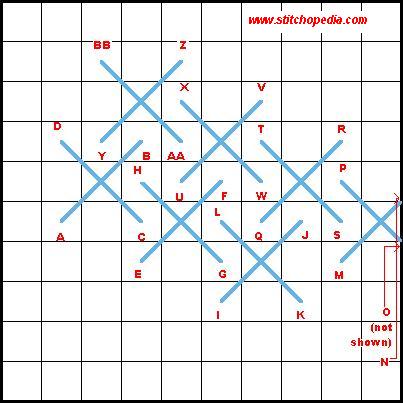
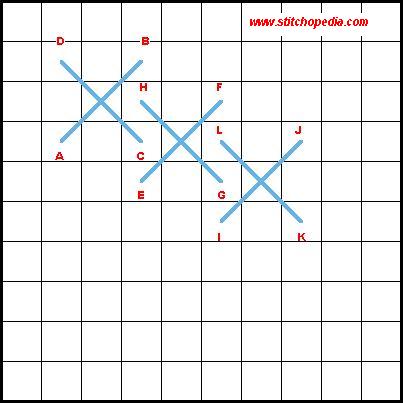
The Staggered Cross Stitch is a series of large and small cross stitches. The small
 
cross stitches are worked in between the large ones. This creates an interesting diagonal pattern. Three diagrams have been used to demonstrate this stitch. Clicking on the PRINTABLE VERSION icon, located at the end of the series of diagrams, will direct you to the page to print these instructions.
Staggered Cross Stitch - Diagram 1
Staggered Cross Stitch - Diagram 2
Staggered Cross Stitch - Diagram 3
Staggered Cross Stitch (Diagram 1):
Bring the needle up at A, move up and to the right over two canvas intersections, bring the needle down at B. Bring the needle up at C, move up and to the left over two canvas intersections, bring the needle down at D. Bring the needle up at E, move up and to the right over two canvas intersections, bring the needle down at F. Bring the needle up at G, move up and to the left over two canvas intersections, bring the needle down at H. Bring the needle up at I, move up
Staggered Cross Stitch (Diagram 2):
Beginning where we left off at L, bring the needle up at M, move up and to the right over two canvas intersections, bring the needle down at N. Bring the needle up at O, move up and to the left over two canvas intersections, bring the needle down at P. Bring the needle up at Q, move up and to the right over two canvas intersections, bring the needle down at R. Bring the needle up at S, move up and to the left over two canvas intersections, bring the needle down at T. Bring the needle up at U, move up and to the right over two canvas intersections, bring the needle down at V. Bring the needle up at W, move up and to the left over two canvas intersections, bring the needle down at X. Bring the needle up at Y, move
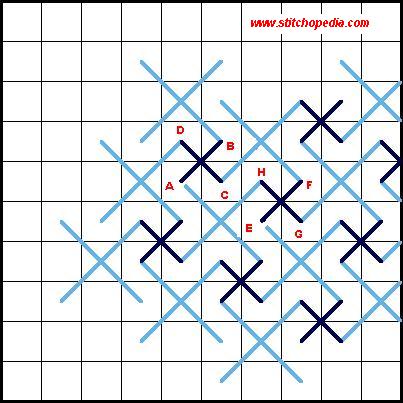
Staggered Cross Stitch (Diagram 3):
This is where we add the small cross stitches (illustrated in dark blue). Bring the needle up at A, move up and to the right over one canvas intersection, bring the needle down at B. Bring the needle up at C, move up and to the left over one canvas intersection, bring the needle down at D. Bring the needle up at E, move up and to the right
Print Me
and to the right over two canvas intersections, bring the needle down at J. Bring the needle up at K, move up and to the left over two canvas intersections, bring the needle down at L. Now, continue on to Diagram 2...
up and to the right over two canvas intersections, bring the needle down at Z. Bring the needle up at AA, move up and to the left over two canvas intersections, bring the needle down at BB. Now, continue on to Diagram 3...
over one canvas intersection, bring the needle down at F. Bring the needle up at G, move up and to the left over one canvas intersection, bring the needle down at H. Continue adding the small cross stitches to the empty spaces in between the larger cross stitches, as illustrated in the above diagram...
Advertisement...
Advertisement...
Advertisement...
Advertisement...
Advertisement...
Advertisement...
Advertisement...
Advertisement...
Do you have a sample of this stitch that you would like to share? If so, click here...
without it unraveling or coming through the back of the fabric -- and forget all about using a delicate floss, such as metallic. Many stitchers also complain that they can never get all the knots to look the same size on the fabric. However, there is an alternative that will give your work a professional look -- the colonial knot.

To do a colonial knot you place the needle behind the standing thread. Then you drop the thread over
the needle, front to back. Push the thread toward the standing thread to form a loop. Pull the thread in front of the standing thread up and over the needle. This should create a drop toward the tip of the needle, to the left of where the first drop occurred.

Now you are going to follow the same instructions as the French knot. You insert the needle tip going over one thread toward the upper right. Then pull the working thread taut so the knot slides down the needle and rests on the fabric. Make sure the knot is tight. Finally, pull the working thread toward the left of the knot. Use your
thumbnail (non-needle hand) to hold the knot while working the thread. Keep the tension on the thread and thumb on the fabric, bring the needle through to the back. You can release the tension a little just as the eye of the needle passes through the knot. But hold on to the remaining thread tension until the next stitch so that the knot is maintained.

And there you have it. Three great tricks performed by the professionals... and now you too.
Article Source: http://www.hobbyarticledirectory.com
John Wigham has been a professional author and editor for 20 years and is a co-founder of Patterns Patch an online cross stitch club dedicated to counted cross stitch. The website has a small team of writers who are devoted to our cross stitch club and enjoy writing about their hobby.
one method keeps the back of your piece looking as good as the front. Also, you can end your threads by weaving them under the same color. If there is not enough of that same color, try to weave it under a similar color in the back. Finally, you can avoid carrying your threads at all. Just end them and restart.

Fabric that Lies Flat:
After using hoops or holding your fabric, wrinkles can become a bane of your
cross-stitchers just resign themselves to the fact that the back of their fabric will never
look as good as the front while looking at those "neatnik" experts with envy. However, there are a few ways you can keep your back looking almost as nice as the front.

First, you can make extra effort to keep your stitches consistent. Use one method of stitching (English or Danish) throughout your whole piece. Using
3 Great Tricks Performed by Cross Stitch Professionals
By: John Wigham

It doesn't matter whether you are a beginner or an experienced cross-stitch stitcher, there are always new things you can learn to give your projects that increasingly polished look. But getting that professional look takes practice and skill, so here are three great tricks the professionals use to make their designs look better than the rest.

Great looking Front and Back:
When you begin cross-stitching one frustrating aspect of the craft is a backside of your fabric that looks like someone threw down a ball of multi-colored floss. Some

HOME

ABOUT US

CONTACT US!

SITE MAP

LINKS


***Stitch Index*** (Alphabetical)
A - I

2,4,6,8 & Tie Stitch

Algerian Eye Stitch

Algerian Eye Daisy
Stitch

Algerian Filling Stitch

Algerian Plait Stitch

Alternating Cross
Stitch

Astrakhan Stitch

Aubusson Stitch

Back Stitch

Bargello Stitch

Basketweave Stitch

Bazaar Stitch

Binding Stitch

Bokhara Couching Stitch

Bokhara Couching Stitch (Diagonal)

Bokhara Couching Stitch (Staggered)

Brazilian Stitch

Brick Stitch

Brighton Stitch

Bullion Knot

Buttonhole Stitch

Buttonhole Stitch (Detached)

Buttonhole Stitch (Double)

Buttonhole Stitch (Tailored)

Buttonhole Stitch (Whipped)

Buttonhole Wheel
Stitch

Byzantine Stitch

Cable Stitch

Cashmere Stitch

Chain Stitch

Chain Stitch
(Braided Variation)

Chain Stitch
(Heavy Variation)

Chain Stitch
(Interlaced Variation)

Chain Stitch (Lazy
Daisy Variation)

Chain Stitch
(Raised Variation)

Checker Stitch

Continental Stitch

Coral Knot Stitch

Couching Stitch

Couching Stitch (Buttonhole Variation)

Couching Stitch (Herringbone Variation)

Couching Stitch
(Open Chain  Variation)

Cretan Stitch

Cretan Stitch
(Diagonal Variation)

Cross Stitch

Cross Stitch (Bound)

Cross Stitch (Diagonal)

Cross Stitch (Heavy)

Cross Stitch (Houndstooth)

Cross Stitch (Reinforced)

Cross Stitch
(Reversed Double)

Cross Stitch
(Staggered)

Cross Stitch (St.Andrew)

Cross Stitch
(St.George)

Cross Stitch (Trame)

Cross Stitch (Triple)

Cross Stitch
(Two-Sided)

Cross Stitch
(Woven)

Cushion Stitch

Czar Stitch

Diagonal Stitch

Darning Stitch

Diagonal Buttonhole Stitch

Diagonal Interlaced Stitch

Diagonal Leaf Stitch

Diamond Stitch

Diamond Eyelet Stitch

Diaper Pattern Stitch

Double Cross Stitch

Double Knot Stitch

Double Star Stitch

Double Stitch

Double Straight
Cross Stitch

Droit Stitch

Eastern Stitch

Economic Stitch

Egyptian Stitch

Encroaching Slanted Gobelin Stitch

Eye Stitch

Eye Stitch with Backstitch

Fan Stitch

Fancy Stitch

Feather Stitch

Fern Stitch

Fishbone Stitch

Fishbone Stitch (Diagonal)

Flame Stitch

Flat Stitch

Flat Stitch (Crossed)

Florentine Stitch

Florentine Stitch (Split)

Fly Stitch (Closed)

French Knot

French Stitch

Ghiordes Knot

Gobelin Stitch

Gobelin Droit Stitch

Gobelin Filling Stitch

Gobelin Stitch
(Trammed Upright)

Greek Stitch

Half Cross Stitch

Herringbone Stitch

Herringbone Stitch (Double)

Herringbone Gone Wrong Stitch

Herringbone Stitch
(Six Step)

Hobnail Stitch

Hungarian Stitch

Hungarian Diamond Stitch

Hungarian Ground
Stitch

Hungarian Ground
Stitch (Diagonal)

Hungarian Point Stitch

Interlocking Gobelin Stitch


***Stitch Index*** (Alphabetical)
I - Z

Irish Stitch

Jacquard Stitch

Kalem Stitch

Kelim Stitch

Kilim Stitch

Knitting Stitch

Knitting Stitch (Diagonal)

Knitting Stitch
(Reverse Tvistom)

Knotted Stitch

Knotted Stitch (Single)

Ladder Stitch

Leaf Stitch

Leaf Stitch (Diagonal)

Leaf Stitch with Backstitch

Leviathan Stitch

Leviathan Stitch (Double)

Leviathan Stitch
(Triple)

Long Armed Cross Stitch

Long Stitch

Long and Short Stitch

Loop Stitch

Mexican Cross Stitch

Milanese Stitch

Montenegrin Stitch

Moorish Stitch

Mosaic Stitch

Mosaic Stitch (Crossed)

Mound Stitch

Nobuko Stitch

Oblique Stitch

Oblique Stitch (Diagonal)

Oblique Stitch (Reverse)

Oblique Slav Stitch

Oblong Cross Stitch

Oblong Cross Stitch with Backstitch

Oriental Stitch

Outline Stitch

Palestrina Stitch

Palace Pattern Stitch

Paris Stitch

Parisian Stitch

Pavillion Stitch

Perspective Stitch

Plait Stitch

Plait Stitch (Crossed)

Plait Stitch (Square)

Plaited Edge Stitch

Plaited Gobelin Stitch

Plaited Interlaced Stitch

Portuguese Cross Stitch

Portuguese Stem Stitch

Princess Pattern Stitch

Pyramid Stitch

Quick Point

Raised Stitch

Raised Cross Stitch

Ray Stitch

Ray Stitch (Expanded)

Renaissance Stitch

Rep Stitch

Reverse Bargello

Reversed Basketweave Stitch

Reversed Cross Stitch

Rhodes Stitch

Ribbed Wheels Stitch

Rice Stitch

Rice Stitch (Padded)

Rococco Stitch

Roman Stitch

Rope Stitch

Roumanian Stitch

Rug Binding Stitch

Rya Stitch

Satin Stitch

Satin Stitch
(Alternating)

Satin Stitch
(Padded)

Scotch Stitch

Scotch Stitch (Alternating)

Scotch Stitch (Condensed)

Scotch Stitch (Crossed)

Scotch Stitch (Woven)

Scottish Stitch

Sheaf Stitch

Shell Stitch

Single Knotted Stitch

Slanted Gobelin Stitch

Smyrna Cross Stitch

Sorbello Stitch

Soumak Stitch

Spanish Stitch

Spider Web Stitch

Split Stitch

Sprats Head Stitch

Square Plait Stitch

Star Stitch

Star Stitch (Large)

Stem Stitch

Stem Stitch
(Diagonal)

Stepped Sheaf Stitch

Surrey Stitch

Sutherland Pattern Stitch

Tapestry Stitch

Tent Stitch

Tent Stitch (Alternating)

Tent Stitch
(Diagonal Mosaic)

Tie Stitch

Trame

Trammed Tent Stitch

Triangle Stitch

Tufting Stitch

Turkey Stitch

Tvistom Stitch

Two Sided Italian
Cross Stitch

Upright Cross Stitch

Van Dyke Stitch

Velvet Stitch

Waffle Stitch

Wave Stitch (Closed)

Wave Stitch (Open)

Weaving Stitch

Web Stitch

Wheat Sheaf Stitch

Woven Band Stitch

Woven Pattern Stitch

BACK TO TOP

The Basics     Composite Stitches     Crossed Stitches    Diagonal Stitches     Looped Stitches     Straight Stitches
Home     About Us     Contact Us      Site Map     Article Archive     Links

Copyright 2006...Stitchopedia...All Rights Reserved
The Four F's (Fish, Fowl, Flowers, Flutterbys)The Four F's (Fish, Fowl, Flowers, Flutterbys)
The Four F's (Fish, Fowl, Flowers, Flutterbys)The Four F's (Fish, Fowl, Flowers, Flutterbys)The Four F's (Fish, Fowl, Flowers, Flutterbys)
The Four F's (Fish, Fowl, Flowers, Flutterbys)The Four F's (Fish, Fowl, Flowers, Flutterbys)The Four F's (Fish, Fowl, Flowers, Flutterbys)The Four F's (Fish, Fowl, Flowers, Flutterbys)
The Four F's (Fish, Fowl, Flowers, Flutterbys)The Four F's (Fish, Fowl, Flowers, Flutterbys)The Four F's (Fish, Fowl, Flowers, Flutterbys)
The Four F's (Fish, Fowl, Flowers, Flutterbys)The Four F's (Fish, Fowl, Flowers, Flutterbys)
The Four F's (Fish, Fowl, Flowers, Flutterbys)
The Four F's (Fish, Fowl, Flowers, Flutterbys)The Four F's (Fish, Fowl, Flowers, Flutterbys)
The Four F's (Fish, Fowl, Flowers, Flutterbys)The Four F's (Fish, Fowl, Flowers, Flutterbys)The Four F's (Fish, Fowl, Flowers, Flutterbys)
The Four F's (Fish, Fowl, Flowers, Flutterbys)The Four F's (Fish, Fowl, Flowers, Flutterbys)The Four F's (Fish, Fowl, Flowers, Flutterbys)The Four F's (Fish, Fowl, Flowers, Flutterbys)
The Four F's (Fish, Fowl, Flowers, Flutterbys)The Four F's (Fish, Fowl, Flowers, Flutterbys)The Four F's (Fish, Fowl, Flowers, Flutterbys)
The Four F's (Fish, Fowl, Flowers, Flutterbys)The Four F's (Fish, Fowl, Flowers, Flutterbys)
The Four F's (Fish, Fowl, Flowers, Flutterbys)
The Four F's (Fish, Fowl, Flowers, Flutterbys)The Four F's (Fish, Fowl, Flowers, Flutterbys)
Stitch-opedia

An encyclopedia of needlepoint Stitches...

Bookmark and Share