John Wigham has been a professional author and editor for 20 years and is a co-founder of Patterns Patch an online cross stitch club dedicated to counted cross stitch. The website has a small team of writers who are devoted to our cross stitch club and enjoy writing about their hobby.
Sun, Sea, Sand, and ... Stitching!
By: John Wigham
Going away on holiday can be a great opportunity to indulge yourself in your favourite pastime... cross stitching, of course! There's the prospect of lots of time to spend on what you want to do, without those guilty feelings that arise when you're stitching at home -- when you know that the garden needs weeding, or that the kitchen
The Woven Cross Stitch derives its name from the way in which the stitch is worked.
The cross stitches are "woven" over and under each other to create a "woven" appearance. There are two variations of the woven cross stitch. Multiple diagrams have been used to demonstrate these stitches. Clicking on the PRINTABLE VERSION icon, located at the end of the series of diagrams, will direct you to the page to print these instructions.
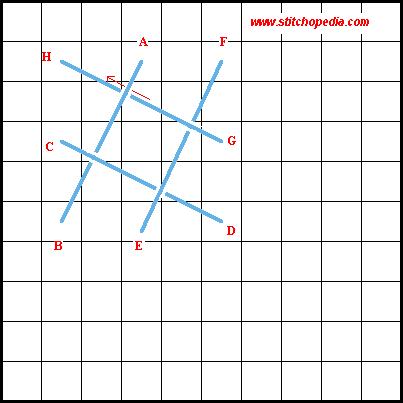


Woven Cross Stitch (Diagram 1):
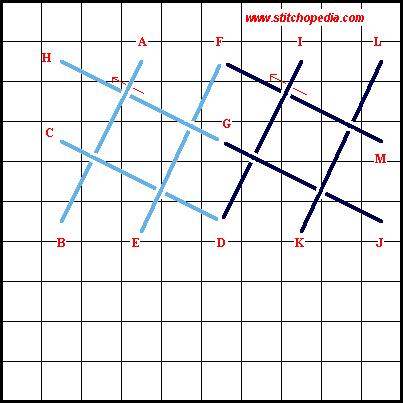
Bring the needle up at A, move down over four canvas threads and to the left over two canvas threads, bring the needle down at B. Bring the needle up at C, move down over two canvas threads and to the right over four canvas threads, bring the needle down at D. Bring the needle up at E, move up over four canvas threads and to the right over two canvas threads, bring the needle down at F. Bring the needle up at G, move up over two canvas threads and to the left over four canvas threads, bring the needle down at H. (Note: At the red arrow the G/H stitch should be worked UNDER the A/B stitch, but NOT under the canvas thread.) Now, continue on to Diagram 2...
Woven Cross Stitch (Diagram 2):
Beginning where we left off at H, we will not start the next woven cross stitch. Bring the needle up at I, move down over four canvas threads and to the left over two canvas threads, bring the needle down at D. Bring the needle up at G, move down over two canvas threads and to the right over four canvas threads, bring the needle down at J. Bring the needle up at K, move up over four canvas threads and to the right over two canvas threads, bring the
Woven Cross Stitch (Diagram 3):
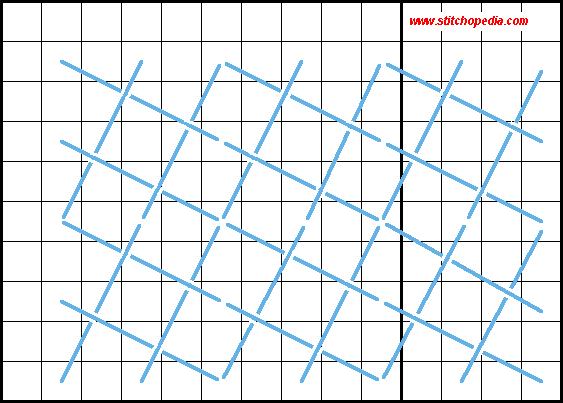
This diagram illustrates how an area of woven cross stitches should look when complete. Click on the Printable Version icon to print these diagrams and instructions.
needle down at L. Bring the needle up at M, move up over two canvas threads and to the left over four canvas threads, bring the needle down at F. (Note: At the red arrow the M/F stitch should be worked UNDER the I/D stitch, but NOT under the canvas thread.) Now, continue on to Diagram 3...
WOVEN CROSS STITCH
(TRIPLE VARIATION)
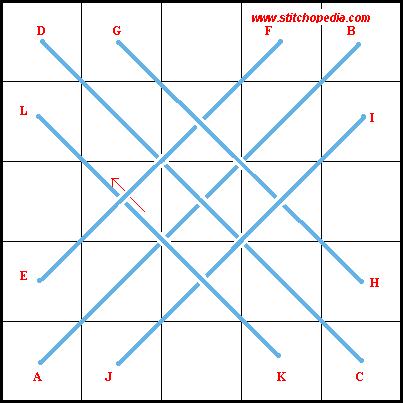
Woven Cross Stitch - Variation (Diagram 1):
This variation of the woven cross stitch creates a more three dimensional look. Bring the needle up at A, move up and to the right over four canvas intersections, bring the needle down at B. Bring the needle up at C, move up and to the left over four canvas intersections, bring the needle down at D. Bring the needle up at E, move up and to the right over three canvas intersections, bring the needle down at F. Bring the needle up at G, move down and to the right over three canvas intersections, bring the needle down at H. Bring the needle up at I, move down and to the left over three canvas intersections, bring the needle down at J. Bring the needle up at K, move up and to the left over three
canvas intersections, bring the needle down at L. (Note: At the red arrow the K/L stitch should be worked UNDER the E/F stitch, but NOT under the canvas thread. To begin the next woven cross stitch, bring the needle up at C, and work the next stitch in the same manner as this one. Click on the Printable Version icon to print these diagrams and instructions.
Do you have a sample of this stitch that you would like to share? If so, click here...
go on, until your stitching paraphernalia fills a large suitcase.
I personally have found that the best projects to take on holiday are small ones -- cards for example. (No, not Christmas cards. You probably won't feel in the mood for stitching Christmas robins or snow scenes when you're on a sunny beach, and besides, your family will conclude that you have finally flipped.)
Despite your best plans, it's unlikely that you'll suddenly be inspired to complete one of those UFO's (UnFinished Objects) that has been gathering dust under a table for
cupboards could do with a clean. No! On holiday your time is mostly your own.
So which cross stitch projects should you consider taking? And how much stitching should you take?
Let's think about what's essential to take, first of all. You'll need your basics: chart, threads, fabric, needles, needle-threader, scissors, magnifier, a few spares... the list can
ages. Two years ago, I took a half-stitched Millennium celebration sampler, started in 1999, to Mexico. Yes, you've guessed it ~ it never left its bag.
I'd recommend a number of cards, packed in kit form, so that all you need is easily accessible. If you do use manufactured card kits, remember that it's not necessary to take the cardboard-part of the project. You may as well leave that part of the kit at home -- it could easily get crushed being transported around - and you can always do the card mounting when you return home.
Place your kits in a zip-locked clear plastic folder so that you don't have to spend too much time rummaging around to find things. The plastic folder will keep out any sand, unexpected
rain or melted ice cream that could spoil your stitching.
Now for the serious bit. Scissors and needles can be dangerous, as you know. Not only that, but if you're travelling by plane and fancy a bit of stitching during the flight, it must be remembered that some airline companies will not allow you to board the plane with scissors in your hand luggage.
There's a good way around this. You can buy a thread cutter, available from most good needlecrafts shops. This hangs round your neck like a pendant. A cheaper way
to cut thread is to use a dental floss container. It has a small blade for cutting floss, and works well with sewing threads too.
Now for those needles... do consider buying a needle container -- don't just use the original paper wrapping. Keep your needles in a customised cylindrical box and not only will you always have needles ready to use, but you can relax in the knowledge that no one will sit on them and hurt themselves.
As for small pairs of scissors, a scissor-keep is a good option for transporting
them. If you don't have one, then plunge the sharp points of your scissors firmly into a cork, and carry them that way. Never take your favourite scissors on a family
holiday. They'll end up being used by everyone for all sorts of functions, believe me.
So now you're packed and ready to go on holiday. Have a wonderful time, and let us know what stitching projects you attempted and even completed on your holiday. Your stitching project could be a valuable memento of the great time you had. Happy holidays!
***Stitch Index*** (Alphabetical)
A - I
***Stitch Index*** (Alphabetical)
I - Z
Copyright 2006...Stitchopedia...All Rights Reserved
An encyclopedia of needlepoint Stitches...