
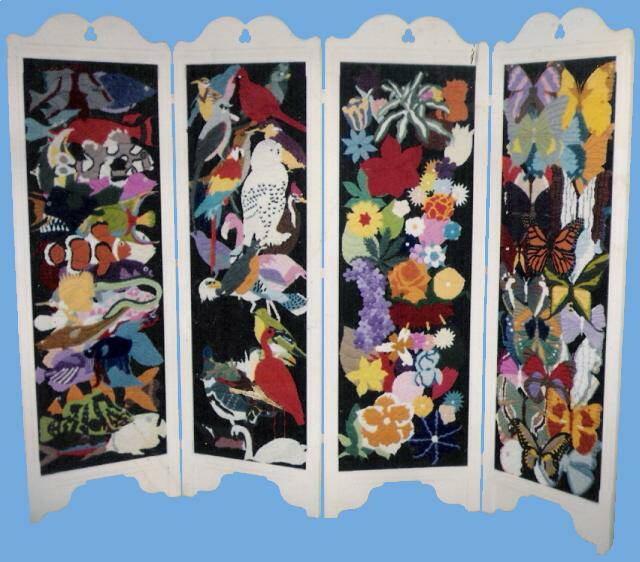
CUSHION STITCH
The Cushion Stitch is an excellent decorative stitch. It also works well as a background stitch. This stitch closely resembles the scotch
stitch. However, because the cushion stitch consists of diagonal stitches that are worked in opposite directions, it does not tend to distort the canvas as much as the scotch stitch. Four diagrams have been used to demonstrate this stitch.
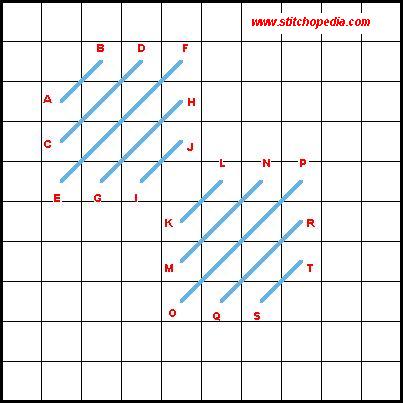
Cushion Stitch (Diagram 1):
Bring the needle up at A, move up and to the right over one canvas intersection, bring the needle down at B. Bring the needle up at C, move up and to the right over two canvas intersectiond, bring the needle down at D. Bring the needle up at E, move up and to the right over three canvas intersections, bring the needle down at F. Bring the needle up at G, move up and to the right over two canvas intersectiond, bring the needle down at H. Bring the needle up at I, move up and to the right over one canvas intersection, bring the needle down at J. Bring the needle up at K, move up and to the right over one canvas intersection, bring the needle down at L. Bring the needle up at M, move up and to the right over two canvas intersectiond, bring the needle down at N. Bring the needle up at O, move up and to the right over three canvas intersections, bring the needle down at P. Bring the needle up at Q, move up and to the right over two canvas intersectiond, bring the needle down at R. Bring the needle up at S, move up and to the right over one canvas intersection, bring the needle down at T. Now, continue on to Diagram 2...
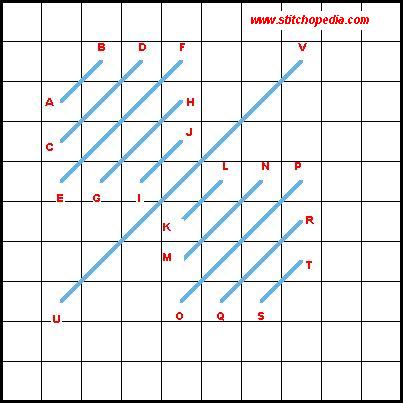
Cushion Stitch (Diagram 2):
This is where we add the long diagonal stitch in the third step of this five-step stitch. Beginning where we left off at T, bring the needle up at U, move up and to the right over six canvas intersections, bring the needle down at V. Now, continue on to Diagram 3...
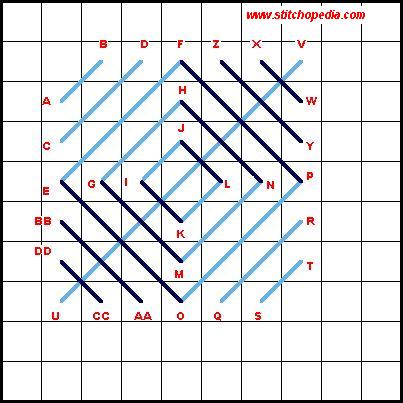
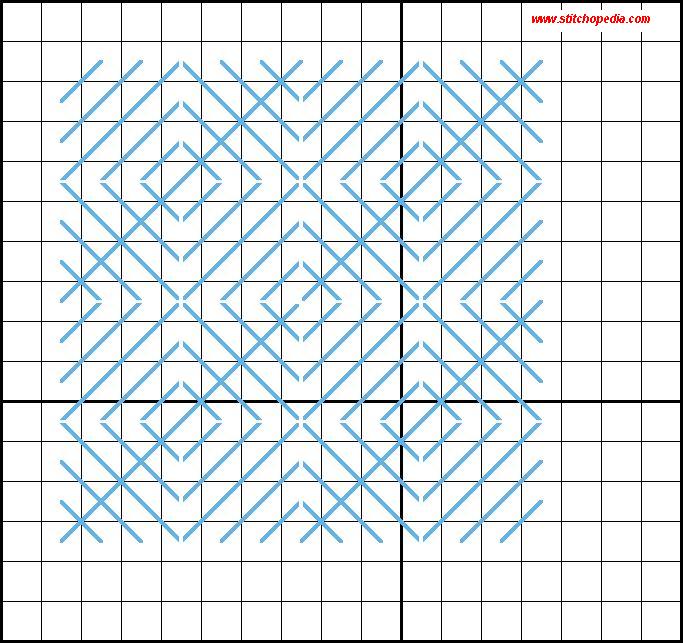
Cushion Stitch (Diagram 4):
This diagram illustrates how four cushion stitches are worked into each other. As you can see, they create a very exciting pattern.
Cushion Stitch (Diagram 3):
At this point, we add the diagonal stitches that slant in the opposite direction. Beginning where we left off at V, bring the needle up at W, move up and to the left over one canvas intersection, bring the needle down at X. Bring the needle up at Y, move up and to the left over two canvas intersections, bring the needle down at Z. Bring the needle up at P, move up and to the left over three canvas intersections, bring the needle down at F. Bring the needle up at N, move up and to the left over two canvas intersections, bring the needle down at H. Bring the needle up at L, move up and to the left over one canvas intersection, bring the needle down at J. Bring the needle up at K, move up and to the left over one canvas intersection, bring the needle down at I. Bring the needle up at M, move up and to the left over two canvas intersections, bring the needle down at G. Bring the needle up at O, move up and to the left over three canvas intersections, bring the needle down at E. Bring the needle up at AA, move up and to the left over two canvas intersections, bring the needle down at BB. Bring the needle up at CC, move up and to the left over one canvas intersection, bring the needle down at DD. This completes the cushion stitch. Now, continue on to Diagram 4...
 | ||||||
Stitch-opedia
An encyclopedia of needlepoint Stitches...

CROSSED CORNERS CUSHION STITCH
Copyright 2006...Stitchopedia...All Rights Reserved
*Stitch Index*
Select the first letter of the stitch you are looking for...
*Stitch Index*
Select the first letter of the stitch you are looking for...
| ||||||
