
EASTERN STITCH
The Eastern Stitch is also known as the Egyptian Stitch. This stitch is a filling stitch that looks best when worked on single canvas. It also
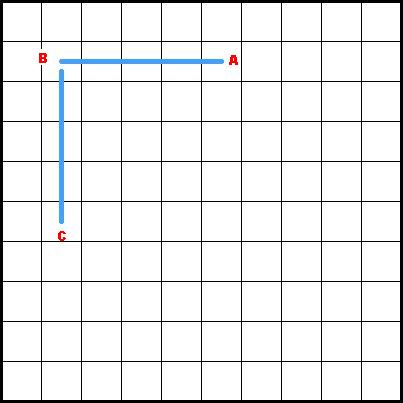
Eastern Stitch Diagram 1:
Bring the needle up at A, move to the right over 4 threads and bring the needle down at B. Going down 4 threads and moving to the left 4 threads, bring the needle up at C. Go up 4 threads and bring the needle down at A. Continue on to Diagram 2...
A
B
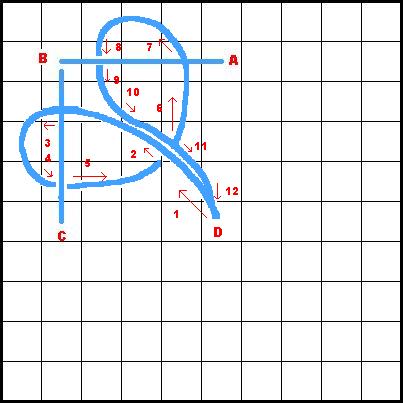
Eastern Stitch Diagram 2:
Note: follow the numbered arrows in Diagram 2 to complete this stitch. Beginning where we left off at A, move to the right over 4 threads and down 4 threads. Bring the needle up at D. Moving to the left (arrow 1 & arrow 2), bring the needle OVER the vertical stitch (arrow 3), pass it UNDER the vertical stitch (arrow 4) and form a loop. Continue moving the needle to the right (arrow 5) and up (arrow 6) to pass the needle OVER the horizontal stitch (arrow 7). Bring the needle down to pass UNDER the horizontal stitch (arrow 8 & arrow 9). Move down (arrow 10 & arrow 11) and bring the needle down at D. As you can see from Diagram 3 (below), the next stitch will begin at C, move over to the right and form the horizontal stitch by bringing the needle down at D. And so on....
B
A
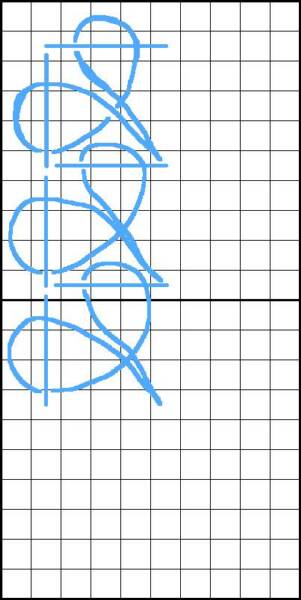
Eastern Stitch (Diagram 3):
As you can see from this diagram, the next stitch will begin at C, move over to the right and form the horizontal stitch by bringing the needle down at D. And so on....
works well in rug designs. The stitch size may be adjusted for almost any size. This stitch is worked horizontally. Three diagrams have been used to demonstrate this stitch.
The Five Basic Types of Needlepoint Stitches
By: Carolyn McNeil
5/1/2007
One of most confusing aspects of learning needlepoint is deciphering the many stitches that are available. If you are working from a kit, it generally isn't a problem. Each kit will specify which stitches should be used and where. However, if you are creating your own project from scratch, where do you go to get help? At stitchopedia.com needlepoint stitches are separated by type and each stitch is explained and demonstrated. The following is a breakdown of the types of stitches available:
Crossed Stitches are probably the most popular type of stitch used today. Crossed Stitches are a principal stitch used in needlepoint tapestry. They are exactly what the name implies - stitches that are created by crossing the threads over each other. The size of the crossed stitch can vary, depending on the thickness of the thread and the gauge of the canvas. It is important, however, to make sure that each crossed stitch covers the canvas. A few examples of crossed stitches are the cross stitch (obviously), fishbone stitch, herringbone stitch and waffle stitch. There are, however, many, many more...
Straight Stitches, again, are exactly what the name implies - straight stitches! These stitches are worked either vertically or horizontally on canvas. They look best when worked on single canvas. They are a great stitch for working large pieces of canvas. However, do not create a stitch that is too long. Some of the more popular straight stitches are the long stitch (aka straight stitch), the florentine stitch (aka bargello), and the back stitch.
Diagonal stitches are stitches that are worked, yes you guessed it, diagonally (at a slant). It is especially important to maintain an even tension when working diagonal stitches. This will help prevent your canvas from warping. Some of the more popular diagonal stitches include: the diagonal stitch (you probably saw that one coming), the basketweave stitch (aka tent stitch) and the continental stitch. Again there are many, many more diagonal stitches available.
Composite stitches are stitches that use more than one type of stitch. Composite stitches are generally large. Because of this, the yarn may not always cover the canvas completely. To help remedy this, try not to pull the yarn too tight when making the stitches. Some composite stitches include the star stitch (aka the algerian eye stitch), the leaf stitch, and the triangle stitch, plus many more.
Looped stitches are also called "Pile Stitches". All of these stitches create a texture with a 3-D look. The pile surface is created by the loops contained in the stitches. Some stitches remain with the loops intact, some require the loops be cut. Although looped stitches are generally used in rug making, they may also be used in any needlepoint project that requires a 3-D or "pile" look. Some of the more interesting looped stitches include the loop stitch, the shell stitch (a very exciting stitch) and the velvet stitch. Again, there are many more available.
These are the main types of stitches available today. The final decision of which stitches to incorporate into your piece will depend on the gauge of the canvas/material you are working on and the type of yarn/thread you are working with. However, we can discuss that subject at another time...

| ||||||
| ||||||
Stitch-opedia
An encyclopedia of needlepoint Stitches...

Copyright 2006...Stitchopedia...All Rights Reserved
*Stitch Index*
Select the first letter of the stitch you are looking for...
*Stitch Index*
Select the first letter of the stitch you are looking for...
| ||||||
