
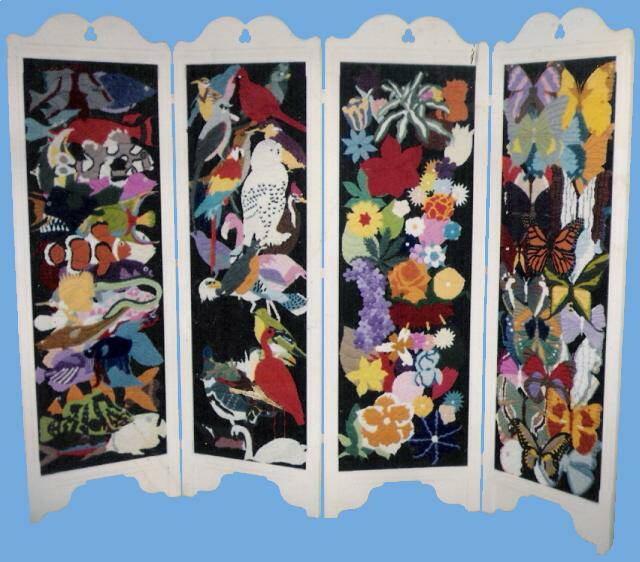
SPLIT FLORENTINE STITCH
The Split Florentine Stitch is a
bargello stitch with an interesting twist. The first row of stitches is worked in the normal bargello "zig-zag" design. The next row, however, is worked up through the former row, splitting the yarn. This is where the name comes from. It is highly recommended that you create the design on graph paper or a needlepoint graph program before you start stitching. The split florentine stitch is an excellent stitch for filling large areas of canvas, such as backgrounds. Three diagrams have been used to demonstrate this stitch.
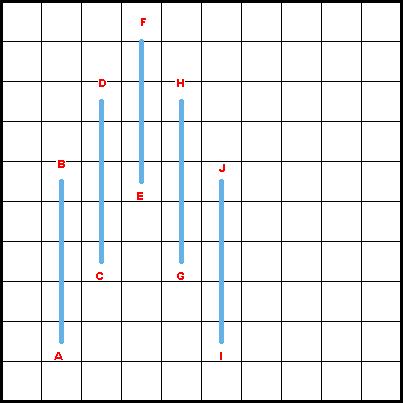
Split Florentine Stitch (Diagram 1):
Bring the needle up at A, move up over four canvas threads, bring the needle down at B. Bring the needle up at C, move up over four canvas threads, bring the needle down at D. Bring the needle up at E, move up over four canvas threads, bring the needle down at F. Bring the needle up at G, move up over four canvas threads, bring the needle down at H. Bring the needle up at I, move up over four canvas threads, bring the needle down at J. Now, continue on to Diagram 2...
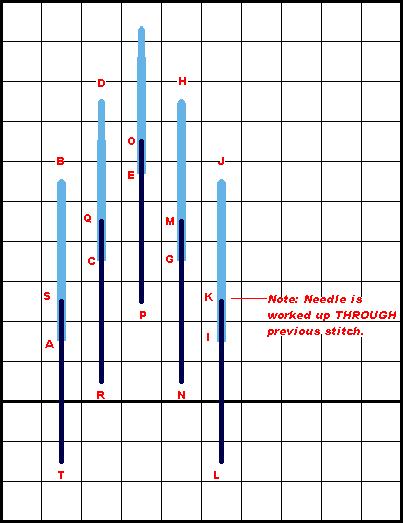
Split Florentine Stitch (Diagram 2):
This second row of stitches is illustrated in dark blue. Bring the needle up at K, move down over four canvas threads, bring the needle down at L. NOTE: The needle is worked up through the bottom of the I/J stitch at K. This is where the previous row of stitches are split and also where the name of the stitch is derived. Bring the needle up at M, move down over four canvas threads, bring the needle down at N. Bring the needle up at O, move down over four canvas threads, bring the needle down at P. Bring the needle up at Q, move down over four canvas threads, bring the needle down at R. Bring the needle up at S, move down over four canvas threads, bring the needle down at T. Now, continue on to Diagram 3...
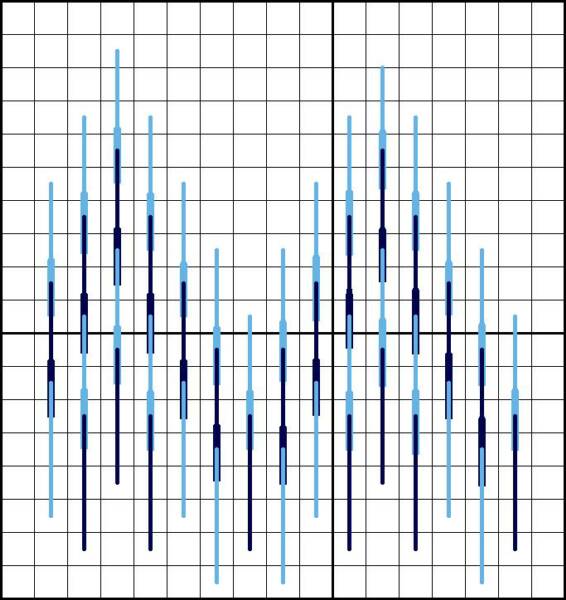
Split Florentine Stitch (Diagram 3):
This diagram illustrates how mulitiple rows of the split florentine stitch should look when complete. Each row is worked into the previous row using the instructions given in diagram 2. The final result will give a thicker look than the diagrams.
 | ||||||
Stitch-opedia
An encyclopedia of needlepoint Stitches...

Copyright 2006...Stitchopedia...All Rights Reserved
*Stitch Index*
Select the first letter of the stitch you are looking for...
*Stitch Index*
Select the first letter of the stitch you are looking for...
| ||||||
