
Print Me
French Stitch Diagram
FRENCH STITCH
The French Stitch is a knotted stitch (aka looped stitch). This stitch consists of  two long straight stitches crossed by short straight stitches. The French Stitch is
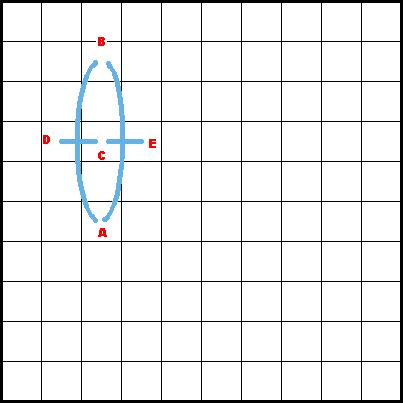
French Stitch (Diagram 1):
The French Stitch may be worked left to right or right to left. In this demonstration, we will work it left to right. Bring the needle up at A. Move up 4 canvas threads and bring the needle down at B. Move down 2 canvas threads and bring the needle up at C. Move to the left over 1 canvas thread and bring the needle down at D (crossing the yarn over the first long straight stitch). Move down 2 canvas threads and over to the right 1 canvas thread and bring the needle up at A (where we started). Move up 4 canvas threads and bring the needle down at B. Move down 2 canvas threads and over to the right 1 canvas thread and bring the needle up at E (crossing the yarn over the second long straight stitch). This completes the first French Stitch. The sample below shows the full pattern. The second row will be worked in
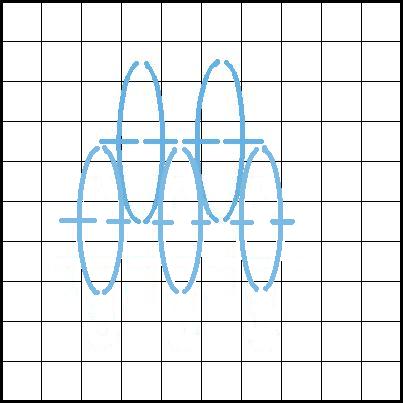
French Stitch (Diagram 2):
This diagram illustrates how the french stitch should be worked in rows. Filling stitches will be needed to cover any canvas areas that show through.
 
interesting because the long straight stitches form a "bow shape" when anchored by the short straight stitches. Two diagrams have been used to demonstrate this stitch. Clicking on the PRINTABLE VERSION icon, located at the end of the series of diagrams, will direct you to the page to print these instructions.
the opposite direction of the first row. Be sure to work the new stitches of the subsequent rows between the row above. This will guarantee that their tops share the canvas hole of the neighboring horizontal stitches.
Advertisement...
Advertisement...
Advertisement...
Advertisement...
Do you have a sample of this stitch that you would like to share? If so, click here...
Does It Work?
Sometimes your choice of stitch is determined by what the design is showing. For example, if you were needlepointing a cat, you probably would not want to use a strong geometric stitch for the cat’s fur (although it might be a very cool background). But if you were stitching a brick wall that kind of stitch might be just the ticket.

The scale of the stitch is also important, it must work with the scale of the area on the canvas. Any stitch you use should be repeated at least three times in all directions, if it does not this stitch is too big for the area. Pick a smaller one. The bigger the scale of the stitch, the more attention it draws to
itself. For example if you were stitching a sunflower, you might want to emphasize the petals or the center. If you wanted to emphasize the center, that’s where you would put the larger stitch. The larger the pattern, the more your eye will be drawn to it.

Sometimes the combination of thread and canvas mesh rules out some kinds of stitches. The thread/stitch combination might be difficult to work as is. In those cases you might want to thin out the threads by using one fewer plies. Or you might 
want to pick another stitch. If the coverage in this combination looks too thin, thicken the thread by adding another strand or adding a strand of crewel wool or embroidery floss in a matching color to your base thread. Usually these additions don’t stand out, but just make the needlepoint look better.

Try Before Deciding
The best method for checking out a stitch is to try
it. Work a bit on a spare piece canvas, make a sample for your stitch notebook, or try a little bit of the stitch on the edges of the canvas. If it doesn’t look right, frog stitch (rip-it-,rip-it). I’ve sometimes done this with entire stitched areas and sometimes I’ve worked the same area several times before I find something which is perfect.

Ultimately, your best judge will be your eye. I have seen canvases which break these rules, which are wonderful. I have also seen canvases which broke these rules and created messes.
But always remember that it’s your needlepoint and your vision. If you like it, and it is fun to stitch, then it is right!

About The Author:
Janet M. Perry is one of the leading writers of needlepoint stitch guides in the world. She writes innovative guides for needlepoint canvases from over
20 designers. She puts into practice her motto to make needlepoint fast, fun and affordable. She is an expert in needlepoint, both on the Web and through her writing as the Needlepoint Pro for Cross-Stitch & Needlework magazine. She works with deigners, shops, and thread manufacturers on new products and regularly reports on trends in needlepoint. Her newest book, Needlepoint Trade Secrets, will be available in the summer of 2007 on Amazon. Visit her website (http://www.napaneedlepoint.com) or blog (http://www.nuts-about-needlepoint.com) to learn about my newest products.
Article Source: http://EzineArticles.com/?expert=Janet_M._Perry
texture. Some of these are Needlepoint Cross Stitch (great for eyes), Skip Tent, T Stitch, and Dotted Swiss.

In needlepoint, Tent Stitch i considered a neutral texture. I think of it like zero on a number line. Many stitches , like Cashmere Stitch for example, are either bigger or higher Tent Stitch. These are the positive numbers and will make areas stitched with them stand out. Other stitches, like Blackwork or Darning Patterns, use thinner threads or have more open space. These are the negative number and will always look lower and lighter than Tent Stitch
gets a place to rest. Without some tent stitch, the canvas will look way too busy and can be difficult to read. Areas which almost always need to be worked in basketweave include areas which have lots of detail (like faces) areas which are very narrow (like these Chinese characters), and areas with shading.

There are also many small stitches which are the same size as Tent Stitch but which add some
Picking Stitches in Needlepoint
By: Janet M. Perry

Whenever you buy a painted canvas or when you design your own needlepoint, you will need to pick stitches for it. Here are some simple rules for deciding what stitch should go where.

Tent Stitch in Needlepoint
Every canvas, no matter how big or small, should have some areas of tent stitch (basketweave). Think of this as “neutral texture.” By having some tent stitch, the eye

HOME

ABOUT US

CONTACT US!

SITE MAP

LINKS


***Stitch Index*** (Alphabetical)
A - I

2,4,6,8 & Tie Stitch

Algerian Eye Stitch

Algerian Eye Daisy
Stitch

Algerian Filling Stitch

Algerian Plait Stitch

Alternating Cross
Stitch

Astrakhan Stitch

Aubusson Stitch

Back Stitch

Bargello Stitch

Basketweave Stitch

Bazaar Stitch

Binding Stitch

Bokhara Couching Stitch

Bokhara Couching Stitch (Diagonal)

Bokhara Couching Stitch (Staggered)

Brazilian Stitch

Brick Stitch

Brighton Stitch

Bullion Knot

Buttonhole Stitch

Buttonhole Stitch (Detached)

Buttonhole Stitch (Double)

Buttonhole Stitch (Tailored)

Buttonhole Stitch (Whipped)

Buttonhole Wheel
Stitch

Byzantine Stitch

Cable Stitch

Cashmere Stitch

Chain Stitch

Chain Stitch
(Braided Variation)

Chain Stitch
(Heavy Variation)

Chain Stitch
(Interlaced Variation)

Chain Stitch (Lazy
Daisy Variation)

Chain Stitch
(Raised Variation)

Checker Stitch

Continental Stitch

Coral Knot Stitch

Couching Stitch

Couching Stitch (Buttonhole Variation)

Couching Stitch (Herringbone Variation)

Couching Stitch
(Open Chain  Variation)

Cretan Stitch

Cretan Stitch
(Diagonal Variation)

Cross Stitch

Cross Stitch (Bound)

Cross Stitch (Diagonal)

Cross Stitch (Heavy)

Cross Stitch (Houndstooth)

Cross Stitch (Reinforced)

Cross Stitch
(Reversed Double)

Cross Stitch
(Staggered)

Cross Stitch (St.Andrew)

Cross Stitch
(St.George)

Cross Stitch (Trame)

Cross Stitch (Triple)

Cross Stitch
(Two-Sided)

Cross Stitch
(Woven)

Cushion Stitch

Czar Stitch

Diagonal Stitch

Darning Stitch

Diagonal Buttonhole Stitch

Diagonal Interlaced Stitch

Diagonal Leaf Stitch

Diamond Stitch

Diamond Eyelet Stitch

Diaper Pattern Stitch

Double Cross Stitch

Double Knot Stitch

Double Star Stitch

Double Stitch

Double Straight
Cross Stitch

Droit Stitch

Eastern Stitch

Economic Stitch

Egyptian Stitch

Encroaching Slanted Gobelin Stitch

Eye Stitch

Eye Stitch with Backstitch

Fan Stitch

Fancy Stitch

Feather Stitch

Fern Stitch

Fishbone Stitch

Fishbone Stitch (Diagonal)

Flame Stitch

Flat Stitch

Flat Stitch (Crossed)

Florentine Stitch

Florentine Stitch (Split)

Fly Stitch (Closed)

French Knot

French Stitch

Ghiordes Knot

Gobelin Stitch

Gobelin Droit Stitch

Gobelin Filling Stitch

Gobelin Stitch
(Trammed Upright)

Greek Stitch

Half Cross Stitch

Herringbone Stitch

Herringbone Stitch (Double)

Herringbone Gone Wrong Stitch

Herringbone Stitch
(Six Step)

Hobnail Stitch

Hungarian Stitch

Hungarian Diamond Stitch

Hungarian Ground
Stitch

Hungarian Ground
Stitch (Diagonal)

Hungarian Point Stitch

Interlocking Gobelin Stitch


***Stitch Index*** (Alphabetical)
I - Z

Irish Stitch

Jacquard Stitch

Kalem Stitch

Kelim Stitch

Kilim Stitch

Knitting Stitch

Knitting Stitch (Diagonal)

Knitting Stitch
(Reverse Tvistom)

Knotted Stitch

Knotted Stitch (Single)

Ladder Stitch

Leaf Stitch

Leaf Stitch (Diagonal)

Leaf Stitch with Backstitch

Leviathan Stitch

Leviathan Stitch (Double)

Leviathan Stitch
(Triple)

Long Armed Cross Stitch

Long Stitch

Long and Short Stitch

Loop Stitch

Mexican Cross Stitch

Milanese Stitch

Montenegrin Stitch

Moorish Stitch

Mosaic Stitch

Mosaic Stitch (Crossed)

Mound Stitch

Nobuko Stitch

Oblique Stitch

Oblique Stitch (Diagonal)

Oblique Stitch (Reverse)

Oblique Slav Stitch

Oblong Cross Stitch

Oblong Cross Stitch with Backstitch

Oriental Stitch

Outline Stitch

Palestrina Stitch

Palace Pattern Stitch

Paris Stitch

Parisian Stitch

Pavillion Stitch

Perspective Stitch

Plait Stitch

Plait Stitch (Crossed)

Plait Stitch (Square)

Plaited Edge Stitch

Plaited Gobelin Stitch

Plaited Interlaced Stitch

Portuguese Cross Stitch

Portuguese Stem Stitch

Princess Pattern Stitch

Pyramid Stitch

Quick Point

Raised Stitch

Raised Cross Stitch

Ray Stitch

Ray Stitch (Expanded)

Renaissance Stitch

Rep Stitch

Reverse Bargello

Reversed Basketweave Stitch

Reversed Cross Stitch

Rhodes Stitch

Ribbed Wheels Stitch

Rice Stitch

Rice Stitch (Padded)

Rococco Stitch

Roman Stitch

Rope Stitch

Roumanian Stitch

Rug Binding Stitch

Rya Stitch

Satin Stitch

Satin Stitch
(Alternating)

Satin Stitch
(Padded)

Scotch Stitch

Scotch Stitch (Alternating)

Scotch Stitch (Condensed)

Scotch Stitch (Crossed)

Scotch Stitch (Woven)

Scottish Stitch

Sheaf Stitch

Shell Stitch

Single Knotted Stitch

Slanted Gobelin Stitch

Smyrna Cross Stitch

Sorbello Stitch

Soumak Stitch

Spanish Stitch

Spider Web Stitch

Split Stitch

Sprats Head Stitch

Square Plait Stitch

Star Stitch

Star Stitch (Large)

Stem Stitch

Stem Stitch
(Diagonal)

Stepped Sheaf Stitch

Surrey Stitch

Sutherland Pattern Stitch

Tapestry Stitch

Tent Stitch

Tent Stitch (Alternating)

Tent Stitch
(Diagonal Mosaic)

Tie Stitch

Trame

Trammed Tent Stitch

Triangle Stitch

Tufting Stitch

Turkey Stitch

Tvistom Stitch

Two Sided Italian
Cross Stitch

Upright Cross Stitch

Van Dyke Stitch

Velvet Stitch

Waffle Stitch

Wave Stitch (Closed)

Wave Stitch (Open)

Weaving Stitch

Web Stitch

Wheat Sheaf Stitch

Woven Band Stitch

Woven Pattern Stitch

BACK TO TOP

The Basics     Composite Stitches     Crossed Stitches    Diagonal Stitches     Looped Stitches     Straight Stitches
Home     About Us     Contact Us      Site Map     Article Archive     Links

Copyright 2006...Stitchopedia...All Rights Reserved
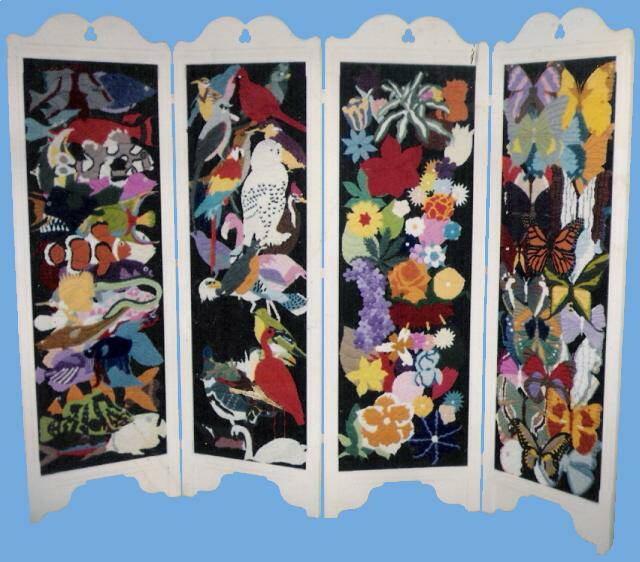
The Four F's (Fish, Fowl, Flowers, Flutterbys)The Four F's (Fish, Fowl, Flowers, Flutterbys)
The Four F's (Fish, Fowl, Flowers, Flutterbys)The Four F's (Fish, Fowl, Flowers, Flutterbys)The Four F's (Fish, Fowl, Flowers, Flutterbys)
The Four F's (Fish, Fowl, Flowers, Flutterbys)The Four F's (Fish, Fowl, Flowers, Flutterbys)The Four F's (Fish, Fowl, Flowers, Flutterbys)The Four F's (Fish, Fowl, Flowers, Flutterbys)
The Four F's (Fish, Fowl, Flowers, Flutterbys)The Four F's (Fish, Fowl, Flowers, Flutterbys)The Four F's (Fish, Fowl, Flowers, Flutterbys)
The Four F's (Fish, Fowl, Flowers, Flutterbys)The Four F's (Fish, Fowl, Flowers, Flutterbys)
The Four F's (Fish, Fowl, Flowers, Flutterbys)
The Four F's (Fish, Fowl, Flowers, Flutterbys)The Four F's (Fish, Fowl, Flowers, Flutterbys)
The Four F's (Fish, Fowl, Flowers, Flutterbys)The Four F's (Fish, Fowl, Flowers, Flutterbys)The Four F's (Fish, Fowl, Flowers, Flutterbys)
The Four F's (Fish, Fowl, Flowers, Flutterbys)The Four F's (Fish, Fowl, Flowers, Flutterbys)The Four F's (Fish, Fowl, Flowers, Flutterbys)The Four F's (Fish, Fowl, Flowers, Flutterbys)
The Four F's (Fish, Fowl, Flowers, Flutterbys)The Four F's (Fish, Fowl, Flowers, Flutterbys)The Four F's (Fish, Fowl, Flowers, Flutterbys)
The Four F's (Fish, Fowl, Flowers, Flutterbys)The Four F's (Fish, Fowl, Flowers, Flutterbys)
The Four F's (Fish, Fowl, Flowers, Flutterbys)
The Four F's (Fish, Fowl, Flowers, Flutterbys)The Four F's (Fish, Fowl, Flowers, Flutterbys)
Stitch-opedia

An encyclopedia of needlepoint Stitches...

Bookmark and Share