
About The Author:
Janet M. Perry is one of the leading writers of needlepoint stitch guides in the world. She writes innovative guides for needlepoint canvases from over 20 designers. She puts into practice her motto to make needlepoint fast, fun and affordable. She is an expert in needlepoint, both on the Web and through her writing as the Needlepoint Pro for Cross-Stitch & Needlework magazine. She works with deigners, shops, and thread manufacturers on new products and regularly reports on trends in needlepoint. Her newest book, Needlepoint Trade Secrets, will be available in the summer of 2007 on Amazon. Visit her website (http://www.napaneedlepoint.com) or blog (http://www.nuts-about-needlepoint.com) to learn about my newest products.
Needlepoint and Focal Points
By: Janet M. Perry
With the many different threads and stitches available to us as needlepointers, it is easy to agree with the saying “This is not your Grandmother’s needlepoint!” We’ve come a long way from the days where endless streams of continental were done by dignified ladies. This is a very good thing.
Having so many threads to choose from, and so many stitches at our disposal
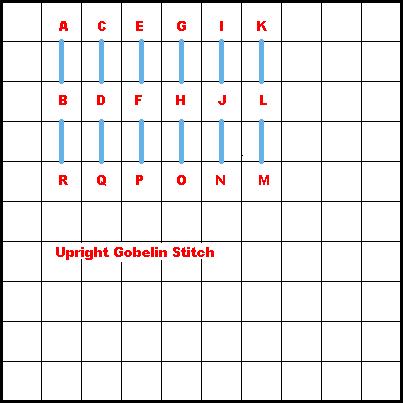
Upright Gobelin Stitch:
Bring the needle up at A, move up over 2 threads, and down at B. Now move on to the next stitch. Starting where we left off at B, bring the needle up at C, move up over 2 threads, and down at D. The next stitch...from D we bring the needle up at E, move up over 2 threads, and down at F. Continue until you reach the end of the row. Here, we have stopped at L.
To start the next row, we begin where we ended at L, bring the needle up at M, move up over 2 threads, and down at K. This row ends in the same spaces that the above row started. Now, starting where we left off at K, bring the needle up at N, move up 2 threads, and down at I. Continue until you reach the end of the row...
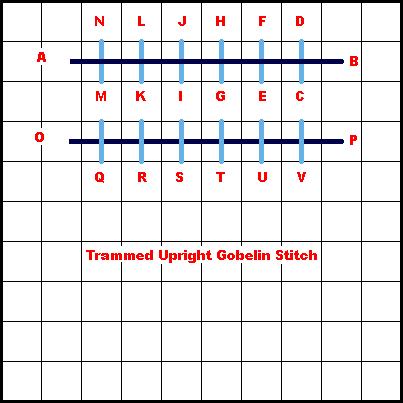
Trammed Upright Gobelin Stitch:
Bring the needle up at A, move right horizontally over your choice of spaces (here we have chosen 6 spaces), and down at B. Starting at B, where we left off, bring the needle up at M, move up over 2 threads, and down at N. Continue until the end of the row, then work another horizontal stitch and begin the upright gobelin stitches again. Basically, you are simply inserting the upright gobelin stitch over a horizontal stitch. The purpose of
Gobelin Filling Stitch:
This stitch is quick to work.
Bring the needle up at A, move up 6 threads, and down at B. Move over 2 threads and down 6 threads, and bring the needle up at C. Move up 6 threads, and bring the needle down at D. Continue in this manner - up at E, down at F, up at G, down at H.
Now we move on to the next row. Starting where we left off at H, move down to 3 threads below G and over 1 thread - this will bring the needle up at I. From I, go up
There are three types of straight Gobelin Stitches (There are also diagonal Gobelin Stitches). They are the Upright Gobelin Stitch (aka straight gobelin stitch), the Trammed
TRAMMED UPRIGHT
GOBELIN STITCH
Upright Gobelin Stitch (similar to the bokhara couching stitches) and the Gobelin Filling Stitch. The Upright Gobelin Stitch is worked horizontally from the top, left to right. These stitches are best when worked on single canvas. The Trammed Upright Gobelin Stitch is worked left to right (for the tram) and then right to left for the gobelin stitch. The trammed stitch is shown in dark blue for demonstration purposes only. The Gobelin Filling Stitch alternates between left to right for the first row, then right to left for the second row and so on...One diagram has been used to demonstrate each of these stitches. Clicking on the PRINTABLE VERSION icon, located at the end of the diagram, will direct you to the page to print these instructions.
this stitch is to give your piece a more hard-wearing surface.
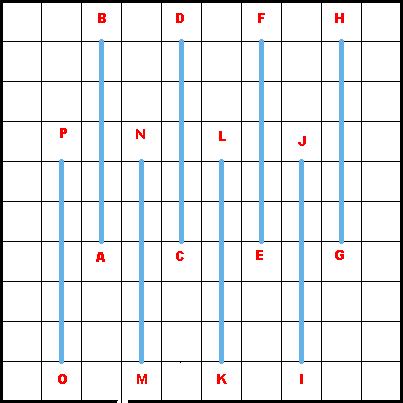
6 threads and down at J. Continue in this manner until you finish the row at P.
Add as many rows as you need, making sure that each row overlaps the previous row by 3 threads (as pictured above).
Do you have a sample of this stitch that you would like to share? If so, click here...
major focal point and there may be a very few additional focal points. The focal point is the most important area of the design and all the stitching everywhere in the piece needs to support it.
Next chose the threads (and maybe the stitches) for your focal point. These should be threads and stitches which make the focal point come towards the viewer. So for example, if your background is going to be wool, make the focal point silk or pearl. Use a more textured stitch, or a lighter color.
You can pick and chose stitches for your design as you go, adding some texture
makes making lovely needle art easy — or is it?
It is all too easy for a canvas to get overwhelmed by too many textures, colors, threads and stitches, so that the piece loses it’s focus and looks like a mishmash instead of something worth the work you put into it.
When you get a new canvas and are thinking about how to stitch it, decide which things in the piece will be your focal points. There should be one
here, picking a different thread there.
1-3-5 Rule for Great Needlepoint Pieces
But keep in mind while you work what I call “Mary Shipp’s Rule.” Mary is an amazing stitcher and teacher and one of my mentors.
She says that there are three aspects of needlepoint thread,
piece which you will finish is much better than one which will languish in your stash.
you plan, keeping in mind Mary’s rule.
And if you start to feel as if you have gone too far — evaluate the piece according to the rule, and make adjustments. Don’t be afraid to rip things out if the piece is not working. a
color and stitches. The line between lovely needleart and confusion is in how many of each of these you use.
In good needleart, one of these should be dominant, another should be “just an accent” and the third should be somewhere in the middle. In fact she uses the proportions 1-3-5 to demonstrate this.
For example, if you are doing a piece in all wool, you could have lots of colors (say a bouquet of flowers) and relatively few stitches (maybe one stitch for the leaves and another for flower center). But you could also have lots of stitches (maybe all the
different furs of animals in a Noah’s Ark piece). And in that case your colors would mostly be browns and tans.
But what if you made every flower a different stitch or every animal a fanciful color? You can probably imagine how confused this would look.
When you are planning to stitch a canvas, start with the focal point and then move on as you stitch (which is what I do) or as
***Stitch Index*** (Alphabetical)
A - I
***Stitch Index*** (Alphabetical)
I - Z
Copyright 2006...Stitchopedia...All Rights Reserved
An encyclopedia of needlepoint Stitches...