
Hungarian Stitch:
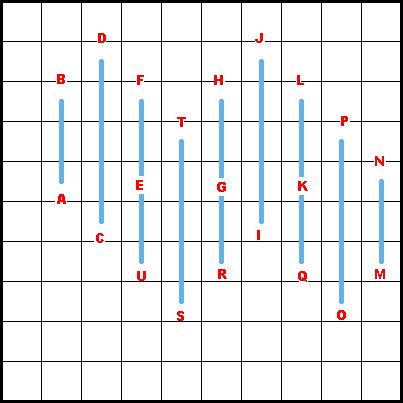
Bring the needle up at A, move up 2 threads and down at B. Move over 1 thread and down 3 threads (1 thread below A), bring the needle up at C. Move up 4 threads and bring the needle down at D. Move down 3 threads (1 thread above C), bring the needle up at E. Move up 2 threads and bring the needle down at F.
To start the next group of 3, move over 2 threads (skipping 1 space) and bring the needle up at G. Move up 2 threads, bring the needle down at H. Move over 1 thread and down 3 threads (1 thread below G), bring the needle up at I. Move up 4 threads and bring the needle down at J. Move down 3 threads (1 thread above I), bring the needle up at K. Move up 2 threads and bring the needle down at L.
To start the next row, move over 2 threads and down 4 threads and bring the needle up at M. Move up 2 threads, bring the needle down at N. Move to the left, over 1 thread and down 3 threads (2 thread below M), bring the needle up at O. Move up 4 threads and bring the needle down at P. Move down 3 threads (1 thread above O), bring the needle up at Q. Move up 2 threads and bring the needle down at K. As you can see, the rows overlap when we share the spaces from the previous row (stitch Q-K). Continue working this row horizontally from right to left and then start the next row moving left to right....
HELPFUL HINT: If you choose to work in more than one color, you may want to work the first row, then skip down to the third row (if it's the same color) and work the first color through. Then, move to the second row, using the second color and work that color through. This is a time saver - instead of going back and forth between colors.
Also, lighter colors should be stitched first. A dark color will show through the back of a light color, creating a shadow where the dark threads have crossed behind the light threads.
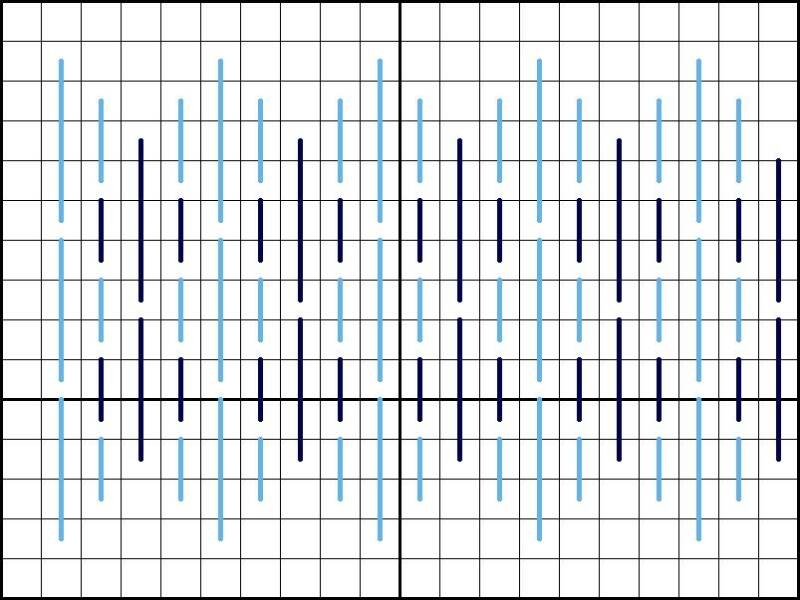
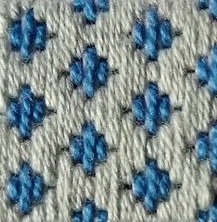
A larger example of the Hungarian Stitch, worked with 2 colors:
HUNGARIAN DIAMOND STITCH
HUNGARIAN
STITCH
When worked diagonally, this stitch is called Mosaic Stitch. The Hungarian stitch is worked horizontally. This stitch
Hungarian Diamond Stitch:
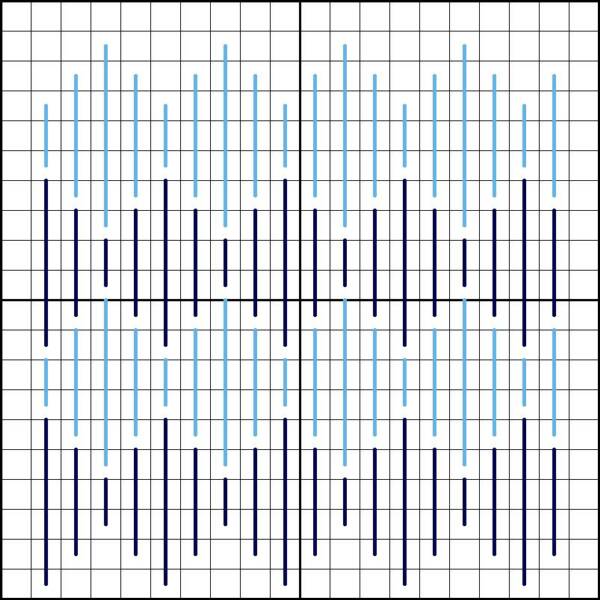
This stitch is identicle to the hungarian stitch, except for the extra straight stitches that are added to form a larger diamond shape.

is worked in groups of 3 stitches. This is a diamond-patterned stitch, composed of graduated stitches. It may be stitched using one color or different colors for each row. Note the two variations of the Hungarian Stitch (the larger version of the hungarian stitch and the hungarian diamond stitch), both worked with 2 different colors. Two diagrams have been used to demonstrate the hungarian stitch and one diagram has been used to demonstrate the hungarian diamond stitch.
| ||||||
| ||||||
Stitch-opedia
An encyclopedia of needlepoint Stitches...

Copyright 2006...Stitchopedia...All Rights Reserved
*Stitch Index*
Select the first letter of the stitch you are looking for...
*Stitch Index*
Select the first letter of the stitch you are looking for...
| ||||||
