
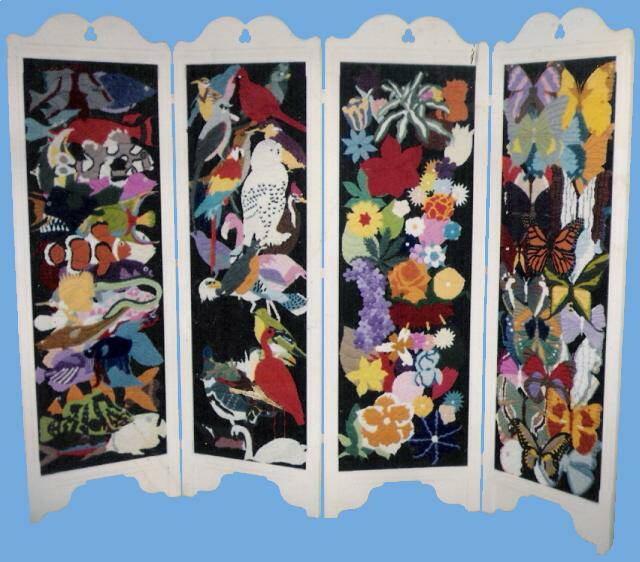
Quick and Easy Needlepoint
By: Jerry Cahill
Needlepoint is a canvas work that can be described as hand-made embroidery, using canvas and wool threads. What makes the needlepoint different is that it is done manually all the way. The stitching threads used may be of wool, silk, cotton or
The Jacquard Stitch is a quick and easy stitch suitable for filling large areas of canvas. It is similar to the Byzantine Stitch, except for the added rows of continental stitches that
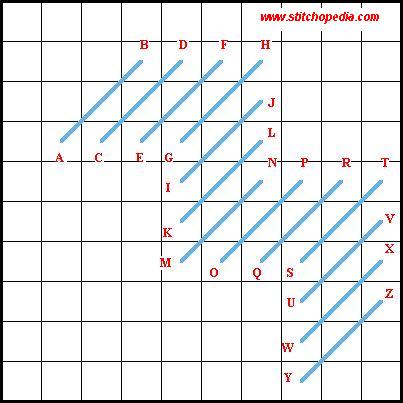
Jacquard Stitch (Diagram 1):
Bring the needle up at A, move up and to the right over two canvas intersections, bring the needle down at B. Bring the needle up at C, move up and to the right over two canvas intersections, bring the needle down at D. Bring the needle up at E, move up and to the right over two canvas intersections, bring the needle down at F. Bring the needle up at G, move up and to the right over two canvas intersections, bring the needle down at H. Bring the needle up at I, move up and to the right over two canvas intersections,
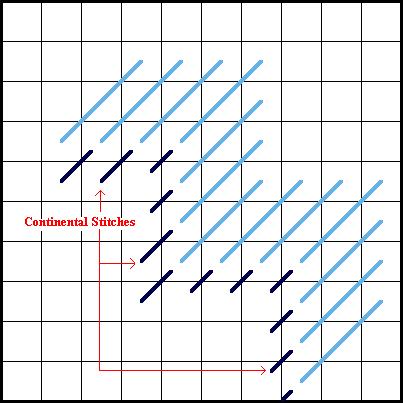
Jacquard Stitch (Diagram 2):
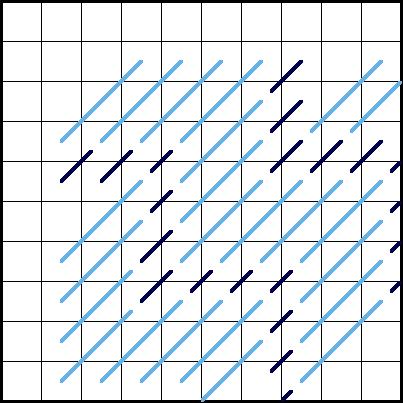
Beginning where we left off at the bottom of the first row, work the Continental Stitches - as shown above - from bottom to top. We have illustrated the Continental Stitches in dark blue. After the row of Continental Stitches is complete, work another row of Byzantine Stitches from top to bottom and so on... Diagram 3 illustrates how the Jacquard Stitch should look when complete.
Jacquard Stitch (Diagram 3):
This diagram illustrates how multiple rows of the jacquard stitch are worked into each other.
separate the Byzantine Stitches within the Jacquard Stitch. The Jacquard Stitch creates a step-like pattern. The size of the steps may vary. For a more interesting look, try using more than one color yarn. Three diagrams have been used to demonstrate this stitch. Clicking on the PRINTABLE VERSION icon, located at the end of the series of diagrams, will direct you to the page to print these instructions.
bring the needle down at J. Bring the needle up at K, move up and to the right over two canvas intersections, bring the needle down at L. Bring the needle up at M, move up and to the right over two canvas intersections, bring the needle down at N. Bring the needle up at O, move up and to the right over two canvas intersections, bring the needle down at P. Bring the needle up at Q, move up and to the right over two canvas intersections, bring the needle down at R. Bring the needle up at S, move up and to the right over two canvas intersections, bring the needle down at T. Bring the needle up at U, move up and to the right over two canvas intersections, bring the needle down at V. Bring the needle up at W, move up and to the right over two canvas intersections, bring the needle down at X. Bring the needle up at Y, move up and to the right over two canvas intersections, bring the needle down at Z.
This completes the first row of Byzantine Stitches within the Jacquard Stitch. Continue on to Diagram 2 to see how the row of Continental Stitches are worked into this row...
Do you have a sample of this stitch that you would like to share? If so, click here...
combinations, such as wool and silk. Other materials that can be used are metallic cord, metallic braid, ribbon, or raffiia. Stitches may be plain, covering just one mesh intersection with a single orientation, or fancy, such as in Bargello. Needlepoint is an artistic activity that can relax the mind. People that practice it, say that it fills them with creative energy and it does not require any special skills.
The needlepoint finds many applications; it
on clothing. The Bargello needlepoint style consists of upright straight stitches of different lengths and colors which produce a characteristic wavy pattern. It is also known as the Florentine work, because it was created in Florence. It is used on pillows, upholstery and even carpets, but not for clothing. In most traditional pieces all stitches are vertical.
Needlepoint requires patience, and it takes tons of work, because a small canvas with the size of a
business card takes about 100,000 stitches to complete or 45 hours. Thus a needlepoint requires an incredible investment of time and energy. Every image you can think of can be worked into needlepoint.
A successful and appealing needlepoint project strikes a balance between the choice of yarn, choice of pattern, choice of color and choice of canvas. The color is
the first choice to make because of the impact color has on our moods. Consider the color wheel and keep it simple. For your needlepoint here are some suggestions for choosing the colors to use.
Keep the choice of colors for your project to two or three colors. You can use lighter or darker versions of the colors but overall, don't use too many different colors, because this can make even the greatest idea appear ugly. Make sure the background color does not overwhelm the accent colors or that it is
not too insipid for the design. Don't use one color that overpowers the others, all the colors should be close to each other and differ smoothly.
Jerry Cahill, publisher and webmaster. Visit his website Online Needlepoint
can be made into pillows or upholstery, or may be displayed on the wall, put in holiday ornaments, purses, stuffed stand-up figures, or even rugs.
Initially, wool threads were used for needlepoint, but nowadays there are many different materials and technologies available. Prior to stitching, the canvas has to be prepared, by using brass tacks and narrow wooden stretcher bars. During all the operations, it is vital to keep the canvas clean to save the difficulties that may occur afterwards. Keep the threads clean from dust and smoke.
The two main styles that have evolved in needlepoint are the Berlin wool work and the Bargello and Hungarian point. The Berlin wool work style started in Berlin, Germany, early in the 19th century. When used, it produces very durable and long lasting pieces of embroidery that could be used as furniture covers, cushions, bags, or even
***Stitch Index*** (Alphabetical)
A - I
***Stitch Index*** (Alphabetical)
I - Z
Copyright 2006...Stitchopedia...All Rights Reserved
An encyclopedia of needlepoint Stitches...