Machine sewing on paper is much the same as sewing on fabric. It takes a little practice, but try not to let the idea intimidate you.
A few tips:
1. Before you start to stitch, make sure your bobbin has enough thread to finish the job. If your bobbin runs out of thread midway, you will be left with holes in the paper that you will have to work to conceal.
2. Do not try to machine stitch more than 3 layers at a time.
3. Do not "knot" the thread as you would when sewing on fabric by going over the same spot repeatedly. Secure the thread underneath by adhering it to piece of paper, and it will not unravel.
The Possibilities
You can stitch with thread, ribbon, yarn, raffia, jute, fibers, and embroidery floss, such as DMC. Floss is inexpensive, widely available, and comes in every shade imaginable. Plus you control the thickness because each floss is made up of 6 strands. Use them all, or just one or two. Or use one or two strands of more than one color.
Once you have had a little practice, you may want to start sewing on everything.
Here are more ideas:
1. Create your own backgrounds and borders by piecing together cardstock blocks or strips.
2. Embellish and attach diecuts for a custom, dimensional
Ready, Set, Sew: How to Stitch and Embroider on Your Scrapbook Pages
By: Susie Cortright
I love the look of sewing on all my papercrafts, from scrapbooking layouts to greeting cards. Sewing and embroidery adds dimension without a lot of bulk and has the
The Mound Stitch stitch begins in the center and works outward. Because of this, it is important to plan the stitch properly.
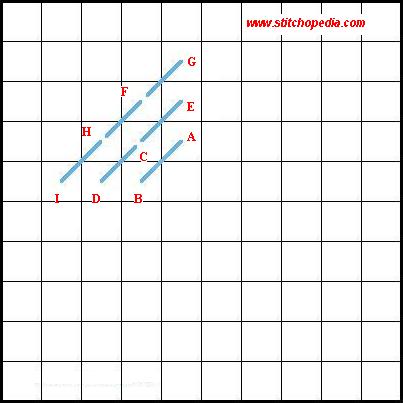
The mound stitch is worked in four directions, which creates a raised look in the shape of a pyramid. Basically, this stitch consists of a series of back stitches worked into triangles. In this particular stitch, the back stitches will closely resemble tent stitches. Four diagrams have been used to demonstrate this stitch. Clicking on the PRINTABLE VERSION icon, located at the end of the series of diagrams, will direct you to the page to print these instructions.
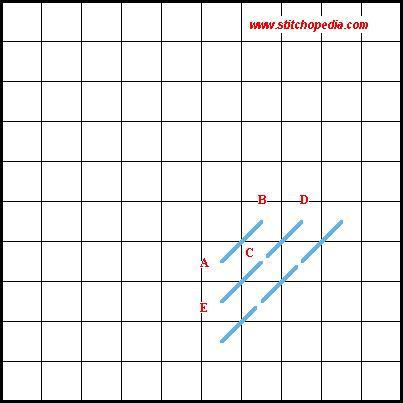
Mound Stitch (Diagram 1):
Bring the needle up at A, move up and to the right over one canvas intersection, bring the needle down at B. Bring the needle up at C, move up and to the right over one canvas intersection, bring the needle down at D. Bring the needle up at E, move up and to the right over one canvas intersection, bring the needle down at C. Although the third row of stitches are shown in this diagram, do not work them yet. At this point, the canvas
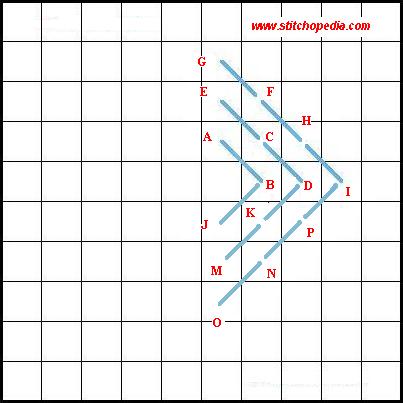
Mound Stitch (Diagram 2):
Now that the canvas is turned upside down, we will begin where we left off at C. Bring the needle up at F, move up and to the right over one canvas intersection, bring the needle down at G. Bring the needle up at H, move up and to the right over one canvas intersection, bring the needle down at F. Bring the needle up at I, move up and to the right
Mound Stitch (Diagram 3):
Now that the canvas is turned sideways, we will begin where we left off at H. Bring the needle up at J, move up and to the right over one canvas intersection, bring the needle down at B. Bring the needle up at K, move up and to the right over one canvas intersection, bring the needle down at D. Bring the needle up at M, move up and to the right over one canvas intersection, bring the needle down at K. Again, we need to turn the canvas before continuing. As with the first triangle of stitches, we will need to turn the canvas upside down to work this last row. Once the canvas is turned, bring the needle up at N and continue working until the row is complete - as with the
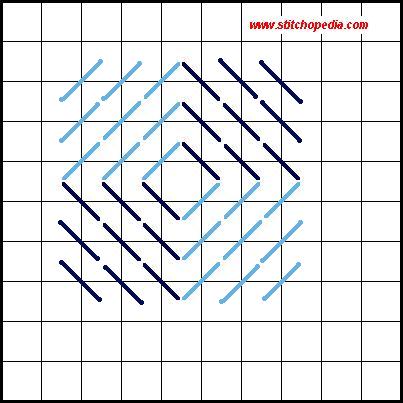
Mound Stitch (Diagram 4):
This diagram illustrates how the mound stitch should look when complete. The number of rows in each triangle may vary according to personal choice or project. For this demonstration, we have chosen to use groups of three.
should be turned upside down to begin the third row. Before beginning the third row, continue on to Diagram 2...
over one canvas intersection, bring the needle down at H. Again, we need to turn the canvas before continuing. This time the canvas should be turned sideways as illustrated in Diagram 3...
second diagram. Now, continue on to Diagram 4...
Do you have a sample of this stitch that you would like to share? If so, click here...
requires.) Another option is to draw or trace a simple design onto lightweight paper (such as tracing paper) and temporarily adhere it to your page so it does not wiggle around during the next step.
What to stitch? It is generally best to keep your design simple and stick to just the
added benefit of attaching elements to the page in the process.
You can sew by hand or with your machine. Both techniques are easier than you might think. Here is a simple how to.
Hand Stitching and Embroidery
Get Ready
Use a pencil to lightly draw the design on cardstock (regular paper generally is not strong enough to withstand all the extra handling that sewing
outline of the image. You can embellish later when you fill in your design with chalks or colored pencils. Popular choices for scrapbooking embroidery include snowflakes, fish, hearts, and flowers, but you can use absolutely any simple design you can find.
Where can you find simple designs? Make a freehand drawing or trace your favorite designs from diecuts, stickers, stamps or templates. Here are two ideas I loved from Creating Keepsakes magazine: Trace a design from your kids' favorite coloring books or trace around your child's hand or foot and embroider the outline.
Get Set
Place your page on a surface that is firm, yet allows a little "give." I like to use a mouse pad or my Coluzzle mat. You can also use a pillow, cushion, or a piece of Styrofoam. Now pierce holes in the cardstock about every 1/8 of an inch depending on the effect you want to achieve, while following the lines of your design.
Choose a piercing tool most appropriate for the thickness of your thread. If you will be using thread or floss, use a straightpin, a needle, or a safety pin. For larger holes, use a pushtack or a paper piercing tool. Again, you will want to consider the look you are trying to achieve before choosing a tool. (If you marked your page with pencil, this is the time to erase.)
Stitch!
Stitch the design. The backstitch is the simplest, but you can experiment with different stitches as you practice the technique.
Now you can fill in the design with chalk, if you wish. You can also apply chalk directly to the floss to create just the right color.
Machine Sewing on Paper
look.
3. Create paper or fabric pockets to hold journaling blocks, extra photos, or simple memorabilia.
4. Stitch around lettering and titles.
5. Embellish journaling blocks.
6. Draw attention to a photo by stitching on the mat
7. Adhere vellum to your background. (Vellum is translucent, so it will often show the glue that lies beneath it. Try stitching it on instead.)
8. Create decorative handmade accents that you attach to a page. One popular technique combines sewing with tearing. Sew along an edge first, then tear just on the other side of your stitches. Push the torn edge up.
***Stitch Index*** (Alphabetical)
A - I
***Stitch Index*** (Alphabetical)
I - Z
Copyright 2006...Stitchopedia...All Rights Reserved
An encyclopedia of needlepoint Stitches...