
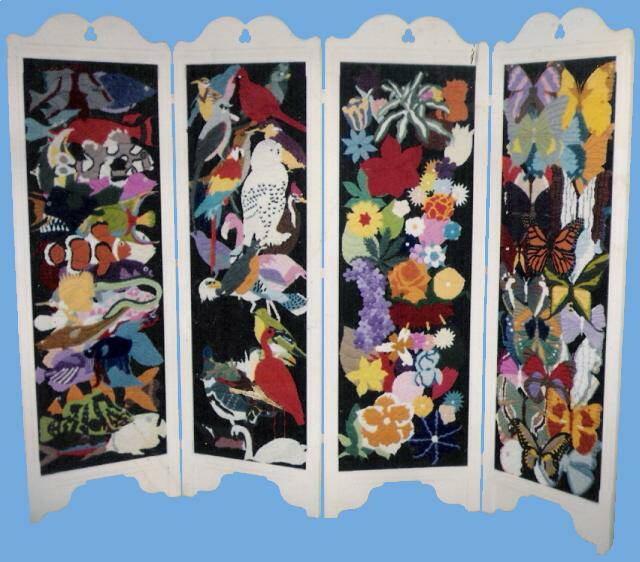
The Rya Stitch is also known as The Single Knotted Stitch. This stitch creates the texture of carpet pile. After the stitches are worked,
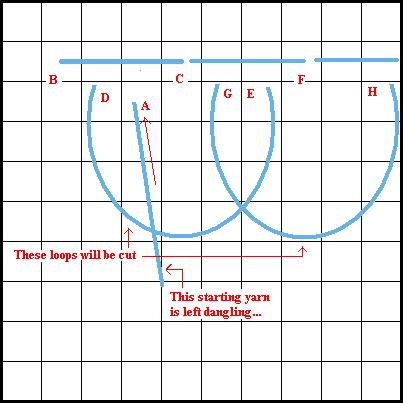
Rya Stitch (Diagram 1):
Insert the needle down at A, leaving a small length of yarn dangling free. Bring the needle up at B, move to the right across three canvas threads, bring the needle down at C. Bring the needle up at D, create a loop, bring the needle down at E. (You will need to hold the loop in place.) Bring the needle up at C, move to the right across three canvas threads, bring the needle down at F. Bring the needle up G, create a loop OVER the right side of the previous loop, bring the needle down H. Continue in this manner until the row is complete. At that time, you may want to cut the loops - or wait until the work is finished. The next row will be worked directly under the first row. This will prevent any canvas from showing.
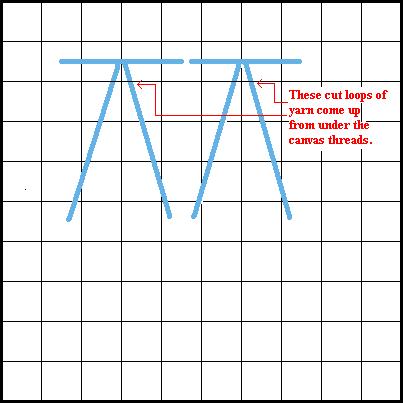
Rya Stitch (Diagram 2):
This diagram illustrates how the loops should look after they have been cut.
the loops are cut to create the "carpet pile" appearance. This stitch may be worked on Mono or Penelope Canvas. The demonstration below is on Mono Canvas. Two diagrams have been used to demonstrate this stitch. Clicking on the PRINTABLE VERSION icon, located at the end of the series of diagrams, will direct you to the page to print these instructions.
Do you have a sample of this stitch that you would like to share? If so, click here...
Needlepoint Through The Ages
By: Jo Kefford
In the Middle Ages, the term Needlepoint encompassed a wide range of needlework. It is not unlike the work done today, but had a broader spectrum of techniques. Today, needlepoint is exclusively recognized as the tent stitch. In the Middle Ages, it
was referred to as canvas work in technique - it incorporated the tent, brick, flat, cross, and braid stitches.
Early examples of canvas work are found on ecclesiastical items such as copes, altar cloths, chasubles, and mitres. In later centuries, it is found more often on items such as clothing, bags, cushions, table carpets, and floor carpets.
During the sixteenth century when
inventorying the possessions of the Castle, the Earl of Shrewbury's wife, Elizabeth (Bess) of Harwick (152?-1608) mentions "a long quition of pete point". In 1650, Lady Morton lists her inventory of the Castle in Orkneys "I gryt Sweet Bagg soad with pitty point".
Over the years, canvas work has been used with all types of needlework. Somewhere at the turn of the nineteenth century, canvas work was split into separate "forms". Needlepoint became the tent stitch with varying sizes - "Demi",
being the medium size tent stitch and "Gros", being the large size. While the term "Petit point" denotes the small size, it is still the tent stitch. During this period, Bargello needlepoint encompassed the brick and flat stitches (satin stitch), as well as other embroidery stitches and were now adapted to canvas. Cross stitch was also utilized extensively.
In the Middle Ages, canvas work was worked on a ground fabric that had a fairly even weave such as linen or hemp. The flax plant produces the material required to make linen. The cannabis plant produces the material used to make oils, rope, and cloth. Because of its strength and durability, sailcloth and tents were often made from hempen cloth. It is believed that hempen cloth is where "canvas" got its name and the tent stitch derived its name from the products.
Although hempen cloth was strong and very durable, it was not necessarily a rough cloth. Herodotus wrote, "Hemp grows in the country of Scythians which except in thickness and height of stalk very much resembles Flax in qualities mentioned,
however Hemp is much superior. The Thracians make clothing of it very like linen, nor could any person without being very will acquainted with the substance, say whether this clothing was made of Hemp or Flax."
It is interesting that "Poldavie" canvas from Brittany, was widely used as sailcloth and fabric for tents and beds but was also among the fabrics available for embroidery in Edinburgh during 1562. It might have appeared to be evenly woven linen but could have been made from hempen. It wasn't until the late Middle Ages that wools became popular in canvas work, especially when imitating tapestries or carpet.
Today, a wide variety of materials are available, however, hempen cloth is obviously no longer one of them. Silk, wool,
cotton, and metallics are the primary materials used today. Canvas is available in many sizes and even-weave cloths are easy to find. The popularity of canvas work has increased throughout the ages regardless of the change in terminology or the
materials used. Though known by many names, a rose by any other name is still a rose. Enjoy!
About the Author
Jo Kefford has been creating needlework for many years, and loves to encourage others to renew their creative flair. For more top tapestry and canvas work tips, visit http://www.toptapestry.com . All the sources of inspiration you need to complete your very own masterpiece.
***Stitch Index*** (Alphabetical)
A - I
***Stitch Index*** (Alphabetical)
I - Z
Copyright 2006...Stitchopedia...All Rights Reserved
An encyclopedia of needlepoint Stitches...