
Needlepoint - The Funniest Way to Stitch
By: Robbie Darmona
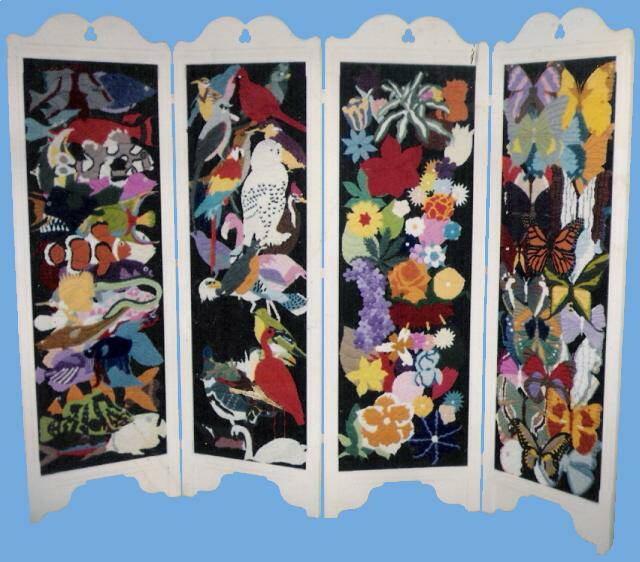
Needlepoint can be described as a hand-made embroidery, using canvas and wool threads. The difference between embroidery and needlepoint is that in needlepoint all the work is done manually. Why so, you may ask? Because IT MAKES FUN.
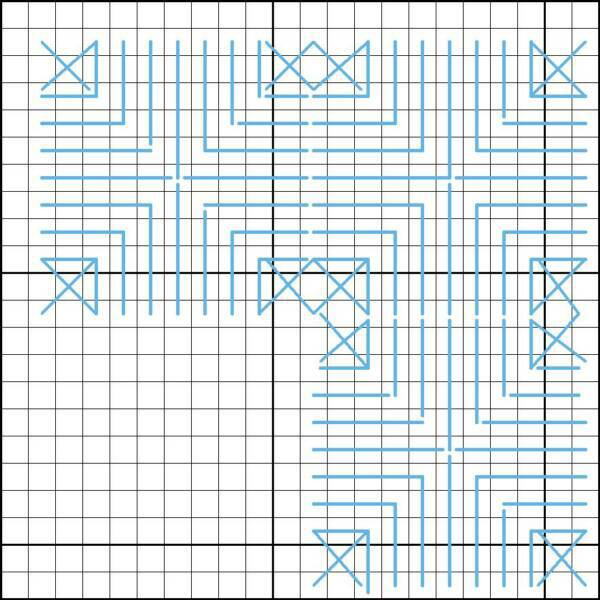
The Triangle Stitch, when complete, will form a square made up of triangles, hence the name. This stitch is especially interesting
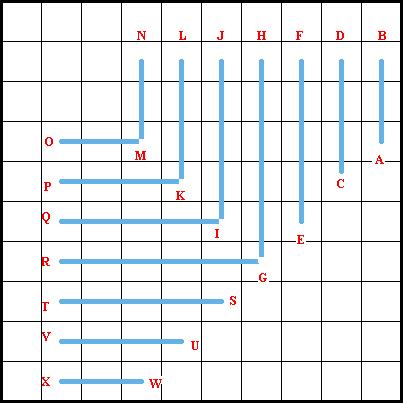
Triangle Stitch (Diagram 1):
Bring the needle up at A, move up over two canvas threads, bring the needle down at B. Bring the needle up at C, move up over three canvas threads, bring the needle down at D. Bring the needle up at E, move up over four canvas threads, bring the needle down at F. Bring the needle up at G, move up over five canvas threads, bring the needle down at H. Bring the needle up at I, move up over four canvas threads, bring the needle down at J. Bring the needle up at K, move up over three canvas threads, bring the needle down at L. Bring the needle up at M, move up over two canvas threads, bring the needle down at N. Bring the needle up at M, move to the leftt over two canvas threads, bring the needle down at O. Bring the needle up at K, move to the left over three canvas threads, bring the needle down at P. Bring the
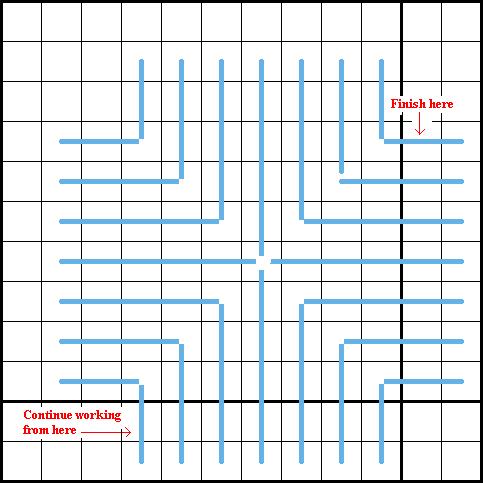
Triangle Stitch (Diagram 2):
Beginning where we left off at X, bring the needle up at W and work the next section of stitches vertically - as the diagram illustrates. After the vertical stitches are complete, work the horizontal stitches. You will finish where you started at Finish here. Now, continue on to Diagram 3...
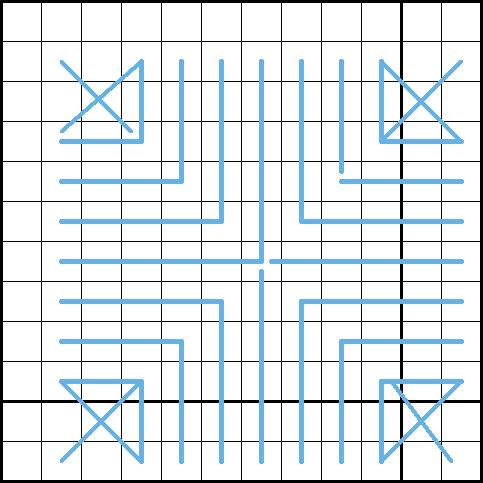
Triangle Stitch (Diagram 3):
This diagram illustrates the cross stitches in each corner of the Triangle Stitch. Diagram 4 will show how a second Triangle Stitch is worked into the first Triangle Stitch and how the next row of stitches should be worked into the first row of stitches.
Triangle Stitch (Diagram 4):
when it is worked with more than one color. In order to make this demonstration easier to follow, we have used four separate diagrams...Four diagrams have been used to demonstrate this stitch. Clicking on the PRINTABLE VERSION icon, located at the end of the series of diagrams, will direct you to the page to print these instructions.
needle up at I, move to the left over four canvas threads, bring the needle down at Q. Bring the needle up at G, move to the left over five canvas threads, bring the needle down at R. Bring the needle up at S, move to the left over four canvas threads, bring the needle down at T. Bring the needle up at U, move to the left over three canvas threads, bring the needle down at V. Bring the needle up at W, move to the left over two canvas threads, bring the needle down at X. Now, continue on to Diagram 2...
Do you have a sample of this stitch that you would like to share? If so, click here...
goldwork, voided ground, crewel, Japanese embroidery, Brazilian embroidery, surface embroidery, ribbon embroidery are just few of them. Traditionally, needlepoint was done with wool threads, using tent stitch on a canvas. But nowadays there are many different materials and technologies used in stitching. They help individual expression and more personal styles to evolve.
Before stitching itself, you have to bear in mind the preparation of the canvas. Use brass tacks and narrow wooden stretcher bars to mount the canvas. Stitching is best
Needlepoint is regarded as a leisure activity, as relaxation and even as a mild form of therapy. People take on stitching because they want to do something themselves: needlepoint is an artistic activity. When stitching, you may come upon different creative inventions and make the canvas according to your individual aesthetic taste.
There are different types of needlepoint: pulled work, drawn work, Hardanger, bargello, blackwork,
on a taut canvas, so the canvas should be attached carefully on the stretcher bars. Blocking canvas embroidery is done after stitches are completed, and before taking the canvas to a professional for framing. Dampen the canvas and stretch it again on a blocking board for 24 hours. After that procedure, the canvas is ready to be framed.
You have to keep the embroidery clean after you have started the stitches. The canvas should be covered by
special cloth, for example tissue paper. Leave open only the area on which you are working at the moment. Needlepoint may take a month, because you don’t hurry to complete the canvas, so you should have in mind this advice. Keep the canvas as clean as possible to save the difficulties that may occur afterwards. Keep the threads clean from dust and smoke.
Nearly everyone enjoys needlepoint as it is relaxing and entertaining. If you try it, you may even get addicted. Needlepoint is best when travelling or during your leisure time. It gives you creative energy, and it doesn’t require any special skills. Needlepoint is also a form of art, and you may soon come to discover how amasingly beautiful your artworks have become.
Article by Robbie Darmona - an article writer who writes on a wide variety of subjects. For more information click Needlepoint
Advertisements...
Craft supplies and other products of interest...
***Stitch Index*** (Alphabetical)
A - I
***Stitch Index*** (Alphabetical)
I - Z
Copyright 2006...Stitchopedia...All Rights Reserved
An encyclopedia of needlepoint Stitches...