
WEB STITCH
The Web Stitch is an excellent choice for a filling or background stitch. It must be worked on double canvas. You will see why as the demonstration
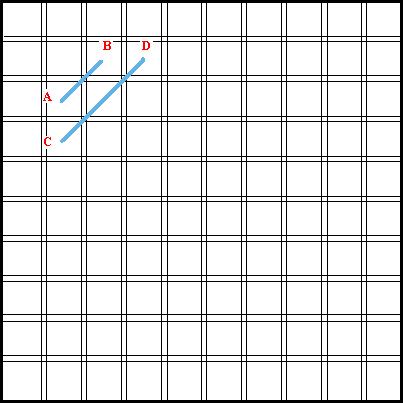
Web Stitch (Diagram 1):
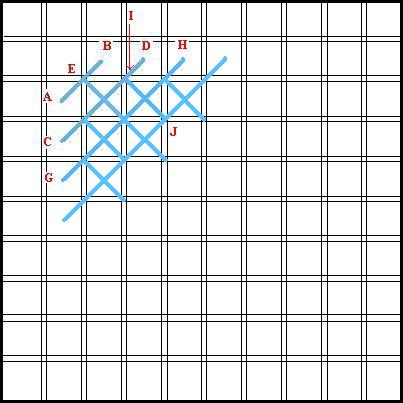
Bring the needle up at A, move up and to the right over one double canvas intersection, bring the needle down at B. Bring the needle up at C, move up and to the right over two double canvas intersections, bring the needle down at D. Now, continue on to Diagram 2...
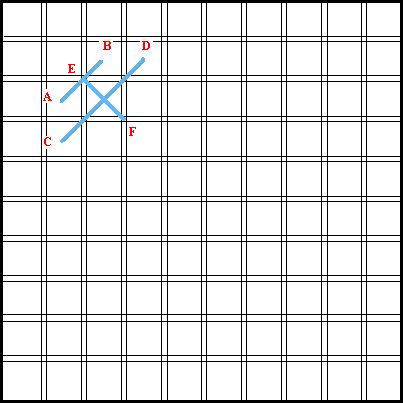
Web Stitch (Diagram 2):
Beginning where we left off at D, bring the needle up at E (see Diagram 3), move down and to the right over one canvas space, bring the needle down at F (see Diagram 3). Now, continue on to Diagram 4...
Web Stitch (Diagram 3):
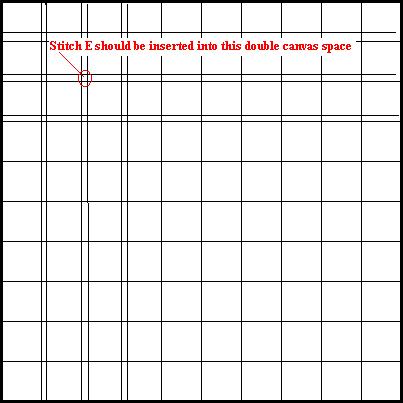
This diagram shows where to insert the needle for the tying stitches (E, F, I, J). You must separate the canvas intersections to insert the needle. This is why this stitch must always be worked on double canvas.
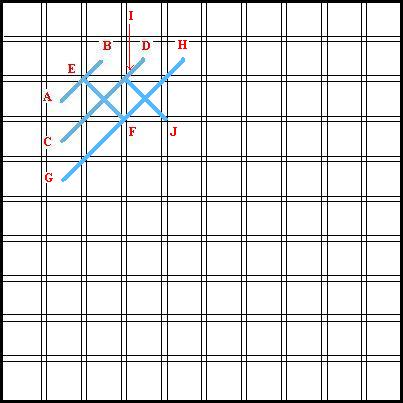
Web Stitch (Diagram 4):
Beginning where we left off at F, bring the needle up at G, move up and to the right over three double canvas intersections, bring the needle down at H. Bring the needle up I (see Diagram 3), move down and to the right over one canvas space, bring the needle down at J (see Diagram 3). Now, continue on to Diagram 5...
Web Stitch (Diagram 5):
This diagram shows the Web Stitch with four diagonal and five tying stitches completed. You may continue with as many stitches as you like - just remember to use tying stitches to prevent snagging.
progresses. This stitch is, basically, a series of diagonal stitches crossed by smaller tying stitches. Five diagrams have been used to demonstrate this stitch.
The Web Stitch
By: Carolyn McNeil
The Web Stitch is a member of the Cross Stitch family. All stitches in the cross stitch family will, at some point, cross within the stitch. The Web Stitch is no exception. This needlepoint stitch, although time-consuming, is easy to work. The Web Stitch is closely woven, making it virtually snag proof. Because of this, it makes an excellent background and filling stitch. It is imperative that this stitch be worked on double canvas (Penelope canvas) only. The reason for this is explained in the details of the stitch.
The Web Stitch consists of diagonal stitches and tying stitches. The diagonal stitch is worked first. The tying stitch is then worked, crossing over the diagonal stitch, thus securing the diagonal stitch in place. The first diagonal stitch will cover only one canvas intersection. This diagonal stitch will not need a tying stitch. The second diagonal stitch will cover two canvas intersections. The tying stitch will cross this diagonal stitch at a right angle and be worked into the “double threads”. This is why it is important that this stitch be worked on double (Penelope) canvas. As the rows are worked the diagonal stitch will become progressively longer. The tying stitches will be worked at each canvas intersection, thus creating the tightly woven look.
Because of the “trammed” nature of this stitch, there is no limit to the length of the diagonal stitch. There are, however, a few negative aspects to the Web Stitch. The Web Stitch has no padding and, therefore, does not wear well over time. If the area you are filling with this stitch is not a square or rectangle shape, it will be necessary to carefully count the threads of the diagonal stitches to be sure that they work out evenly.
For a more interesting look, try using different color yarns/threads for the tying stitches. Do not be afraid to experiment with this stitch. The results may surprise you!
 | ||||||
Stitch-opedia
An encyclopedia of needlepoint Stitches...

Copyright 2006...Stitchopedia...All Rights Reserved
*Stitch Index*
Select the first letter of the stitch you are looking for...
*Stitch Index*
Select the first letter of the stitch you are looking for...
| ||||||
