
DETACHED BUTTONHOLE STITCH
The Detached Buttonhole Stitch may be
resized to suit project needs. Like its sister stitch, the buttonhole stitch, it is worked horizontally from left to right. This stitch would not be appropriate for any piece that receives excessive amounts of wear. This is an excellent filling stitch. The detached buttonhole stitch is also an excellent choice for holding small objects in place (for example, a shell - see Diagram 3). Three diagrams have been used to demonstrate this stitch.
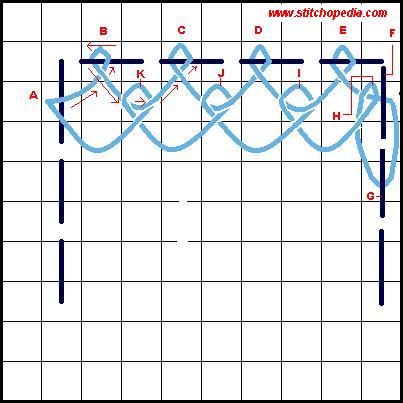
Detached Buttonhole Stitch (Diagram 1):
Before beginning the looped part of this stitch, you need to work back stitches, seen here in dark blue, along the edge of the area you are filling. The loops of this stitch will be worked into these back stitches, not the canvas. Now, once the back stitches are complete, bring the needle up at A, following the red arrows in the diagram, move up and around the back stitch at B. You will create a loop around this back stitch, then move down, leaving extra yarn at K and continue following the red arrows up and around the back stitch at C. Continue working in this manner until you have completed the row at E. At E, you will work the yarn around the back stitch at F and the back stitch at G and then bring the needle up and around the yarn at H. This second row will be worked in the opposite directions of the first row. As you can see from the diagram, these detached buttonhole stitches will be looped around the stitches in the previous row. Now, continue working in this manner until the area you are filling is complete.
Detached Buttonhole Stitch
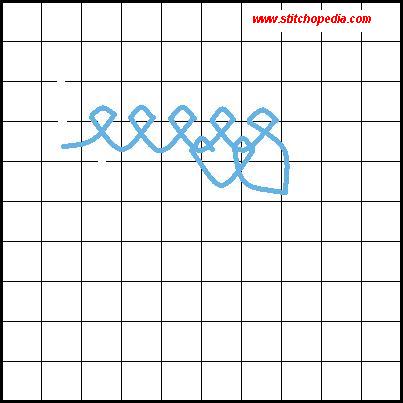
(Diagram 2):
This diagram illustrates how the detached buttonhole stitch will look when it is worked directly onto the canvas, instead of working it onto back stitches - as seen in Diagram 1. Either method is acceptable.
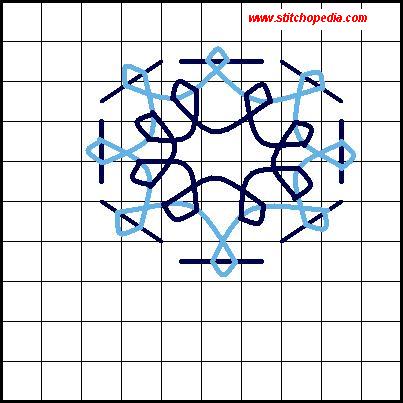
Detached Buttonhole Stitch (Diagram 3):
This diagram illustrates how the detached buttonhole stitch will look when it is worked in preparation of holding an object in place. You may use this variation of the stitch to anchor stones, shells or anything else you can think of...You may adjust the size to fit your piece.
 | ||||||
Stitch-opedia
An encyclopedia of needlepoint Stitches...

Copyright 2006...Stitchopedia...All Rights Reserved
*Stitch Index*
Select the first letter of the stitch you are looking for...
*Stitch Index*
Select the first letter of the stitch you are looking for...
| ||||||
