
SATIN STITCH
The Satin Stitch is often confused with gobelin stitches. The difference lies in the versatility of the satin stitch. This stitch may be resized to
PADDED SATIN STITCH
ALTERNATING SATIN STITCH

fit any project and may also be worked either as a straight stitch or as a diagonal stitch. The lengths of the satin stitches may vary within an area, making it an excellent choice as a filling stitch. Large areas and backgrounds may also be worked with this stitch. In fact, if you combine the straight and diagonal versions of this stitch you may form some very interesting patterns that are suitable backgrounds. Just be careful to not make the stitches too long. Remember, stitches that are excessively long tend to snag. We are demonstrating three variations of the satin stitch. They consist of:the basic satin stitch, the alternating satin stitch, and the padded satin stitch.
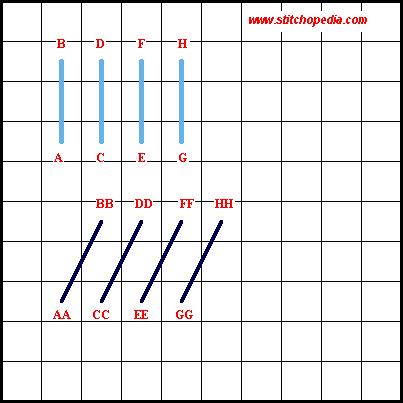
Satin Stitch (Diagram 1):
The upright satin stitch is illustrated in light blue. Bring the needle up at A, move up over two canvas threads, bring the needle down at B. Bring the needle up at C, move up over two canvas threads, bring the needle down at D. Bring the needle up at E, move up over two canvas threads, bring the needle down at F. Bring the needle up at G, move up over two canvas threads, bring the needle down at H. This completes the upright satin stitch - remember, you may use different lengths of yarn for these satin stitches. The slanted satin stitch is illustrated in dark blue. Bring the needle up at AA, move up over two canvas threads and to the left over one canvas thread, bring the needle down at BB. Bring the needle up at CC, move up over two canvas threads and to the left over one canvas thread, bring the needle down at DD. Bring the needle up at EE, move up over two canvas threads and to the left over one canvas thread, bring the needle down at FF. Bring the needle up at GG, move up over two canvas threads and to the left over one canvas thread, bring the needle down at HH. This completes the slanted satin stitch. Click on the Printable Version Icon to print these instructions. Now, continue on to the next series of diagrams for the alternating and padded satin stitches...
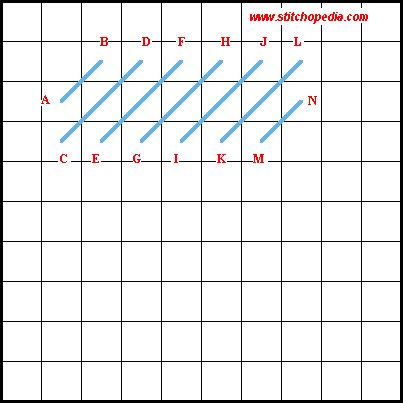
Alternating Satin Stitch (Diagram 1):
Bring the needle up at A, move up and to the right over one canvas intersection, bring the needle down at B. Bring the needle up at C, move up and to the right over two canvas intersections, bring the needle down at D. Bring the needle up at E, move up and to the right over two canvas intersections, bring the needle down at F. Bring the needle up at G, move up and to the right over two canvas intersections, bring the needle down at H. Bring the needle up at I, move up and to the right over two canvas intersections, bring the needle down at J. Bring the needle up at K, move up and to the right over two canvas intersections, bring the needle down at L. Bring the needle up at M, move up and to the right over one canvas intersection, bring the needle down at N. Now, continue on to Diagram 2...
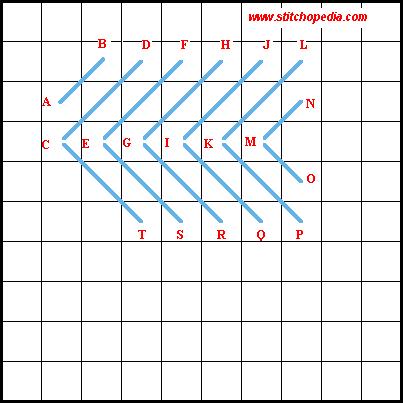
Alternating Satin Stitch (Diagram 2):
The second row should be worked in the opposite direction of the first row. Beginning where we left off at N, bring the needle up at O, move up and to the left over one canvas intersection, bring the needle down at M. Bring the needle up at P, move up and to the left over two canvas intersections, bring the needle down at K. Bring the needle up at Q, move up and to the left over two canvas intersections, bring the needle down at I. Bring the needle up at R, move up and to the left over two canvas intersections, bring the needle down at G. Bring the needle up at S, move up and to the left over two canvas intersections, bring the needle down at E. Bring the needle up at T, move up and to the left over two canvas intersections, bring the needle down at C. This completes the alternating satin stitch. Click on the Printable Version to print these diagrams and instructions. Continue scrolling down to see the padded satin stitch instructions.
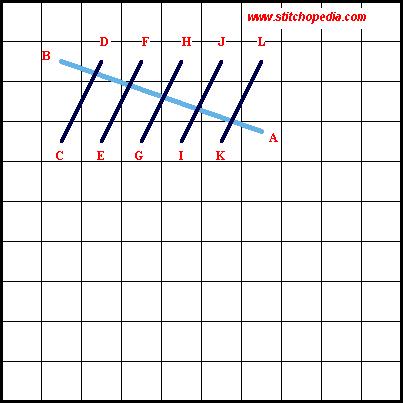
Padded Satin Stitch (Diagram 1):
Two colors have been used to better illustrate this stitch. Bring the needle up at A, move up over two canvas threads and to the left over five canvas threads, bring the needle down at B. This is the "padded" part of the stitch. Next, bring the needle up at C, move up over two canvas threads and to the right over one canvas thread, bring the needle down at D. Bring the needle up at E, move up over two canvas threads and to the right over one canvas thread, bring the needle down at F. Bring the needle up at G, move up over two canvas threads and to the right over one canvas thread, bring the needle down at H. Bring the needle up at I, move up over two canvas threads and to the right over one canvas thread, bring the needledown at J. Bring the needle up at K, move up over two canvas threads and to the right over one canvas thread, bring the needle down at L. This completes one row of padded satin stitches. When complete, you should not be able to see the horizontal stitch.
| ||||||
| ||||||
Stitch-opedia
An encyclopedia of needlepoint Stitches...

Copyright 2006...Stitchopedia...All Rights Reserved
*Stitch Index*
Select the first letter of the stitch you are looking for...
*Stitch Index*
Select the first letter of the stitch you are looking for...
| ||||||
